Images & photos · Image Metadata Privacy Tool
MakerNote: The Proprietary Block Camera Makers Hide Inside EXIF
· Background
exif image-privacy file-formats
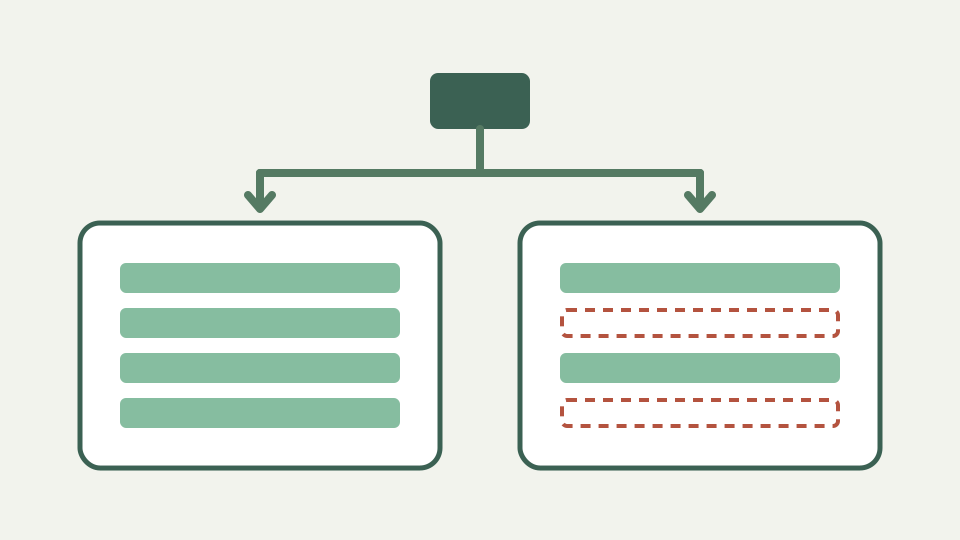
Inside the Exif sub-IFD sits a tag whose contents each manufacturer defines privately, holding serial numbers, shutter counts, focus points, lens IDs and firmware details. Its undocumented layouts are why many tools show it as opaque bytes, and why stripping removes it whole.
The biggest tag you cannot read — the problem of a large 'undefined' block that most viewers skip
MakerNote can be one of the largest and least readable EXIF values because its type is an opaque byte sequence whose internal layout is not interpreted by this product. The parser can label the tag and classify it as device-related, but displaying a short list of byte values is not the same as decoding camera settings or proving what the blob contains.
What this implementation knows about MakerNote
The repository identifies MakerNote by its tag dictionary and UNDEFINED-compatible TIFF reader, then stops at that boundary. The workbook included a standards interpretation and numeric tag detail that the code alone cannot establish as a complete external specification. The defensible implementation claim is that the tag is recognised while vendor internals are deliberately not chased.
What MakerNote may contain
The product note says a MakerNote can hold serial numbers and focus data, and the config adds that vendor blobs may contain device details. “Can” is important: the tool does not enumerate shutter counts, autofocus points, lens identifiers or firmware from the blob. Those examples remain possibilities rather than fields shown in the report.
Reverse engineering and fragility — how community projects documented the formats, why some sections are obfuscated, and why offsets break when the block is moved
Vendor layouts can depend on camera model, byte order and offsets relative to other data, so guessing would create false values. ToolAcre chooses a bounded general TIFF parser instead of reverse-engineering private variants. If detailed diagnostics matter, keep the untouched source and use manufacturer-aware software whose support can be verified for that exact camera.
Why editors keep it and strippers drop it — the choice between preserving the block untouched and removing it whole
Editors may keep MakerNote for technical workflows, while a privacy derivative may not need it. The cleaner does not make a per-tag keep-or-drop decision: it removes the entire EXIF block, taking readable exposure values, timestamps, location, Orientation and MakerNote together. That all-or-nothing cost should be understood before download.
Privacy implications — identifiers that survive when standard tags are edited, because few tools rewrite inside the MakerNote
An opaque device blob deserves attention precisely because it cannot be fully reviewed here. The interface surfaces MakerNote among device fields, and whole-block removal avoids leaving unknown private content merely because it was unreadable. It does not prove anonymity, because identifiers can remain visible or in unsupported channels.
What this does not cover — decoding any specific manufacturer's layout; this post explains the category, not the contents
The tool does not decode MakerNote field by field, preserve selected EXIF values or clean unsupported RAW and TIFF files. It also cannot guarantee that no vendor data exists elsewhere in a container. Colour profiles remain by design and compressed picture data is treated as opaque, including any information hidden inside it.
Takeaway: treat it as opaque and remove it whole — the Image Metadata Privacy Tool strips the entire EXIF block, MakerNote included, without re-encoding the image
Treat MakerNote as opaque and remove it whole when the sharing copy does not need camera diagnostics. Preserve the original for service or archival use, then verify the cleaned derivative. This approach is honest about uncertainty: it neither invents a vendor interpretation nor leaves the recognised EXIF container in place.