 5 Min Read
Privacy & Forensics
How to Strip Sensitive GPS & Camera EXIF Before Sharing
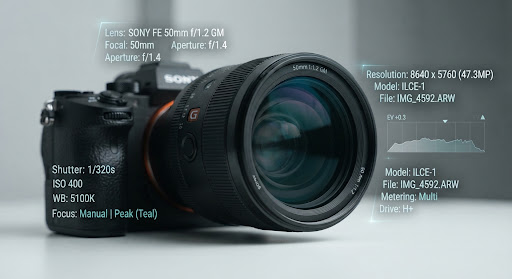
Understand how smartphones embed exact latitude, longitude, and device fingerprints inside JPEG headers.
Updated June 2025
arrow_forward

Convert files, clean data, inspect tokens, and edit images in milliseconds. Processing happens locally in your browser with WebAssembly — your private documents never touch our servers.
Execute instantaneous transformations without switching views. Drag, drop, or input directly below.
Drop PDF files here, or browse
Local handoff • 64 MiB per file{ "sub": "1234567890", "name": "John Doe", "iat": 1516239022 }
Combine multi-page PDF documents locally in browser RAM with live thumbnail page sorting.
Downsample raster elements and strip unused metadata streams without cloud uploading.
Batch convert PNG, JPG, and GIF assets into ultra-light modern formats via WebWorker threads.
Erase GPS coordinates, device serial numbers, and camera signatures prior to public sharing.
Transform tabular CSV/TSV into nested JSON payloads, arrays of objects, or NDJSON files.
Decode claims, verify exp/nbf timestamps, and inspect signature algorithms locally.
Compute intrinsic fair value with sensitivity tables for WACC and terminal growth rates.
Cryptographically secure passphrase generation via window.crypto with EFF wordlists.
Strip bloated editor attributes, remove hidden layers, and collapse paths using SVGO locally.
Generate crisp vector SVG QR codes with logo embedding and adjustable error correction.
Encode and decode binary files or strings with MIME detection and raw byte offset mapping.
Compare strings, config files, or raw JSON with side-by-side or unified inline visual diffing.
Prettify messy SQL queries with standardized indentations for Postgres, Snowflake, and BigQuery.
Simulate investment portfolio projections with periodic contribution scaling and tax-drag offsets.
Spreadsheet-like GUI to compose, align, and copy pipe-delimited Markdown tables effortlessly.
Convert milliseconds and seconds into ISO-8601, RFC-2822, and human relative durations.
5 Min Read
Understand how smartphones embed exact latitude, longitude, and device fingerprints inside JPEG headers.
 8 Min Read
A rigorous walkthrough of WACC formulas, perpetuity growth rates, and sensitivity analysis.
 6 Min Read
Comparing traditional SaaS upload pipelines against client-side WebAssembly isolation.
 4 Min Read
Handling unescaped quotes, inconsistent date formats, and carriage returns in memory.
Unlike traditional utility hubs that upload your confidential PDFs or CSVs to cloud compute instances, ToolAcre runs standard compiled binaries directly inside your browser tab.
Compiled C, Rust, and Go libraries execute close to native hardware speed inside the V8 engine. The browser process performs all rasterization and file serialization locally.
Runtime: WASM SIMD Enabled
Network DevTools inspections verify zero payload POST requests. All inputs are held in volatile RAM (TypedArrays and Blobs) and destroyed the moment you close the tab.
Audit: CSP 'connect-src: none'
Our Progressive Web App caches the complete library payload. Once loaded, you can disconnect your Wi-Fi entirely and process sensitive enterprise files without internet access.
Cache: ServiceWorker v2.4
ToolAcre passes strict static edge network containment audits. Zero user data retention.
Not to a ToolAcre file-processing server. PDF, image, spreadsheet, subtitle and text tools read, process and write local files inside your browser. The page may still request site assets, disclosed site-connection scripts and consent-controlled services. Two tools in the catalogue deliberately contact named external hosts; they are identified in the privacy section above and on their own pages.
No. There is no account system anywhere on this site.
There is no server limit, because there is no server. The real limit is your device’s memory.
Because the technique a browser can use rasterises every page, which destroys the selectable text and often makes a text document larger. Rather than ship that behind a friendly button, the PDF Toolkit leaves it out and the guide explains what to do instead.
No. Browsers have no dependable way to decode HEIC, so those files are rejected with a clear message.
Almost nothing. Most tools keep nothing at all, so reloading discards your work by design. The invoice tool is the exception: it keeps what you entered in your browser’s local storage until you clear it, and says so.
Looking for another way to get the job done? Explore independent tools and services grouped by the kind of work you are doing.
These are independent websites. Check each service's privacy policy and limits before sending it anything sensitive.
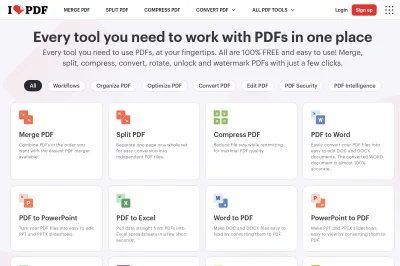
 iLovePDFMassive suite of tools for merging, splitting, compressing, and converting PDF files online.Visit site

 SmallpdfA polished platform offering easy-to-use tools to edit, convert, and compress PDFs.Visit site
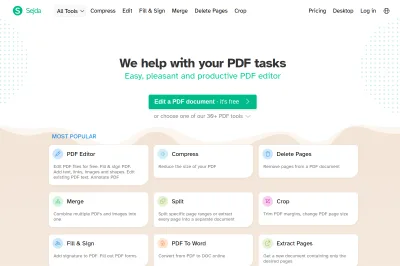
 SejdaProductive online PDF editing with tasks like splitting, merging, and signing documents.Visit site
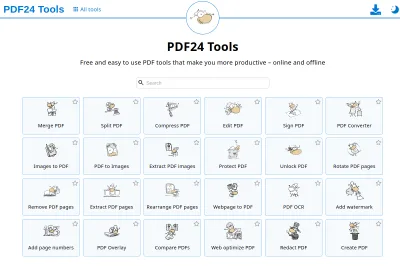
 PDF24 ToolsFree and unlimited PDF tools with strong privacy features and no watermarks.Visit site
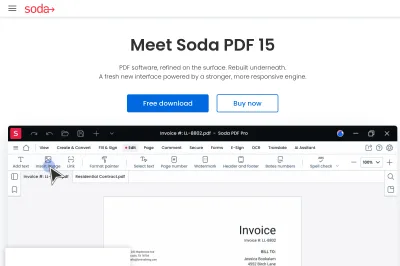
 SodaPDFVersatile PDF software to read, create, convert, edit, and secure PDF files.Visit site
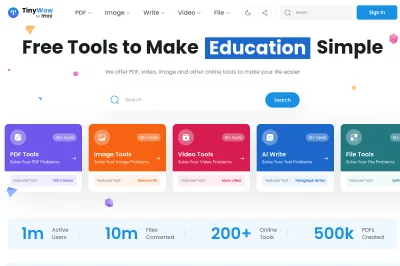
 TinyWowA massive free collection of tools for PDFs, videos, and images with no hourly limits.Visit site
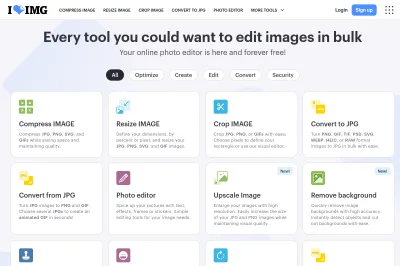
 iLoveIMGBulk image editing tools to compress, resize, crop, and convert image files.Visit site
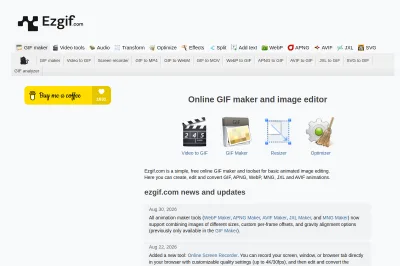
 EzgifSimple online GIF maker and toolset for basic animated GIF and image editing.Visit site
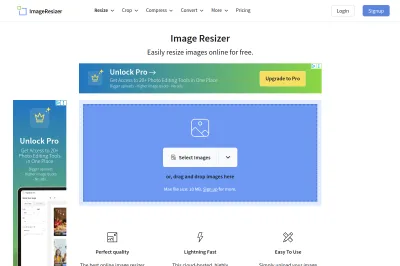
 ImageResizerQuickly crop, resize, and compress images online for free without losing quality.Visit site
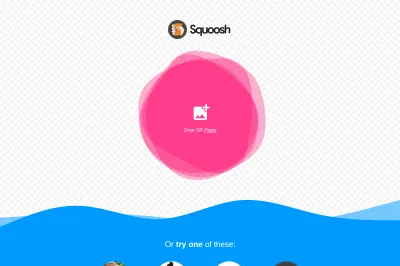
 SquooshA privacy-first image compression web app that runs entirely in-browser.Visit site
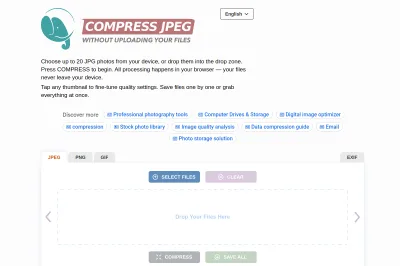
 CompressJPEGA highly popular and simple batch image compressor for JPEG, PNG, and GIF files.Visit site

 PhotopeaAdvanced online image editor supporting PSD, XCF, Sketch, XD, and CDR formats.Visit site

 123appsA large suite of web apps for quickly editing and converting video and audio files.Visit site

 ClideoAll-in-one platform to create, edit, compress, and merge video files online.Visit site

 KapwingCollaborative online video editor and meme generator with modern multimedia tools.Visit site
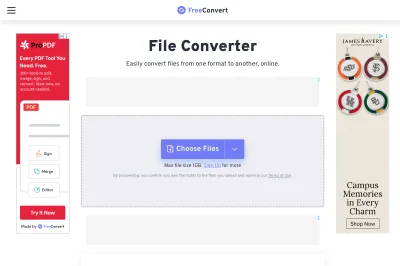
 FreeConvertHigh-quality online file converter supporting large media formats up to 1GB.Visit site
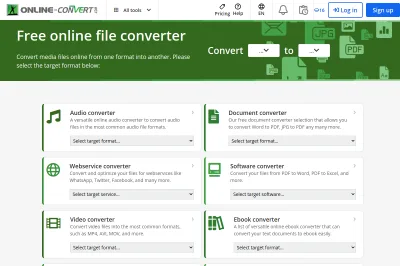
 Online-ConvertFast and versatile online tool to convert audio, video, image, and document files.Visit site

 Veed.ioProfessional online video suite for recording, editing, and adding subtitles to videos.Visit site
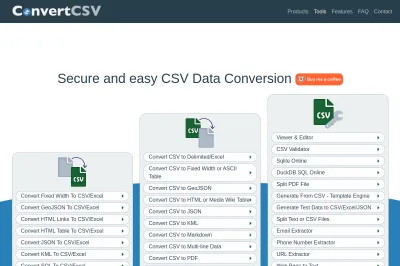
 ConvertCSVUtilitarian tools for converting CSV to JSON, XML, HTML, and other data formats.Visit site
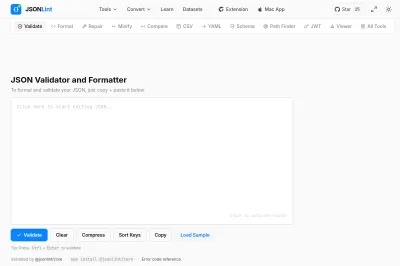
 JSONLintThe industry-standard JSON validator and formatter for debugging structured data.Visit site

 CodeBeautifyExtensive collection of formatters, validators, and converters for JSON, XML, and CSV.Visit site

 JSON Editor OnlineA powerful web-based tool to view, edit, format, and validate JSON data efficiently.Visit site

 ExtendsClassFree online tools for developers including JSON, CSV, XML, and database testers.Visit site

 Browserling ToolsA massive directory of simple text, data, and web utilities tailored for programmers.Visit site
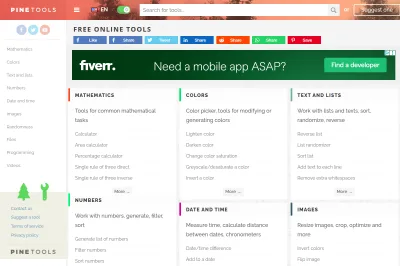
 PineToolsHundreds of simple online utilities covering math, text, colors, and generators.Visit site

 10015 ToolsAn all-in-one toolbox offering text, image, coding, and basic daily utilities.Visit site

 Omni CalculatorThousands of custom-built calculators covering finance, physics, math, and everyday utility.Visit site

 TextFixerFree online tools for formatting text, generating random data, and manipulating strings.Visit site

 Calculator.netA vast array of free online calculators ranging from mortgages to health metrics.Visit site
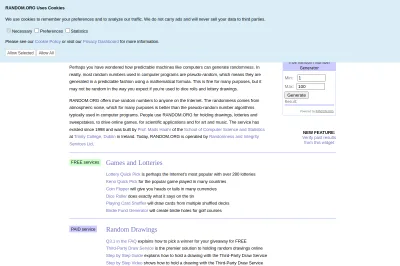
 Random.orgTrue random number generator offering utility tools for drawing, coin flips, and sorting.Visit site
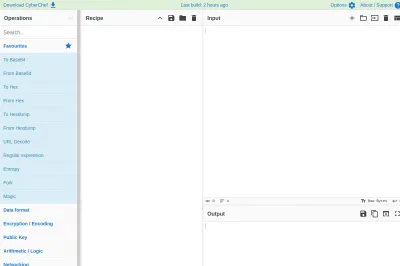
 CyberChefThe cyber Swiss Army knife for encryption, encoding, compression, and data analysis.Visit site

 IT ToolsA clean, open-source collection of handy, client-side tools for developers and IT staff.Visit site
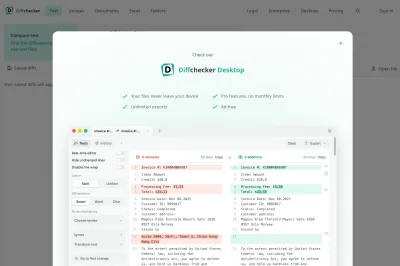
 DiffcheckerThe leading online diff tool to compare text files, code blocks, and images.Visit site
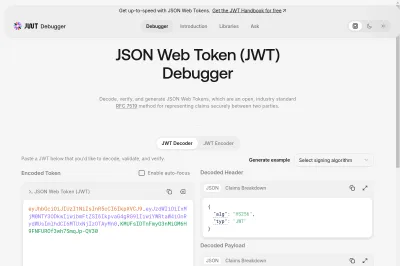
 JWT.ioAn industry-standard tool to decode, verify, and generate JSON Web Tokens.Visit site

 RegExrAn interactive tool to learn, build, and test Regular Expressions with real-time feedback.Visit site

 Base64DecodeA simple and reliable online tool specifically for encoding and decoding Base64 strings.Visit site