Developer tools · UUID generator
Nil and Max UUIDs: The Two Special Values and When to Use Them
· Background
uuid developer-workflow data-validation
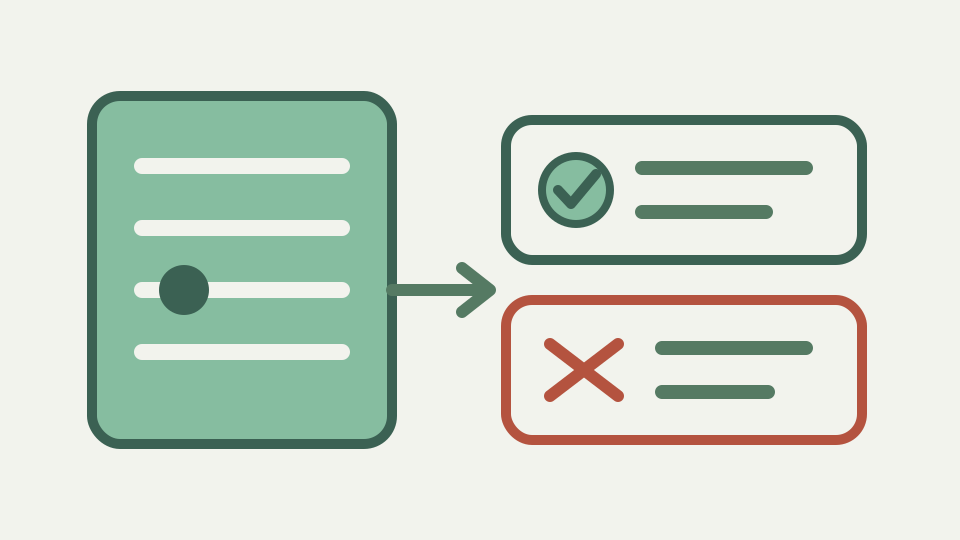
The all-zero Nil UUID has been in the standard since 2005 and the all-F Max UUID joined in 2024. This post explains what they are for, how they interact with validators, and the sentinel-value mistakes to avoid.
The row with ID 00000000-0000-0000-0000-000000000000 — how a placeholder becomes a production bug
A row whose identifier is 00000000-0000-0000-0000-000000000000 can look UUID-shaped while carrying a different meaning from a generated identifier. If an application quietly uses that value for “not assigned yet,” every unfinished row shares the same marker. Code that assumes any accepted UUID names a real object may then request, cache, or join on the placeholder as though it were an ordinary key. The visible format does not communicate the business rule; only an explicit sentinel contract does.
The production bug begins when one layer knows about the placeholder and another does not. A form may submit Nil, an API may accept it, and a persistence layer may store it, while a downstream worker treats every non-null string as a usable foreign key. The failure is not that Nil is malformed. ToolAcre deliberately recognizes it. The failure is allowing “valid text,” “generated identifier,” and “assigned relationship” to collapse into one unchecked condition.
The Nil UUID — its definition, and why every version and variant check technically fails on it
In the checked implementation, Nil is the canonical all-zero string. It receives a dedicated branch before the normal UUID pattern is tested, so isValidUuid returns true even though the regular expression requires a version digit from 1 through 8 and an RFC-variant nibble from 8 through b. inspectUuid follows the same exception: it reports a valid value, assigns version 0, and says that the UUID is all zero bits and not random. This is verified application behavior, not a general claim that every validator must make the same choice.
That branch matters because Nil does not pass the ordinary version-and-variant route used for generated identifiers. A ToolAcre version-4 value carries 4 in the version position and one of 8, 9, a, or b in the variant position; Nil carries zero in both places. Calling those checks “failed” without mentioning the exception would be misleading. The checker first recognizes the special value, then bypasses the ordinary pattern by design. Consumers need equally visible ordering if they accept it.
The Nil UUID is an explicit valid exception in ToolAcre, reported as version 0
The all-f string ffffffff-ffff-ffff-ffff-ffffffffffff receives no special branch in this repository. It also fails the normal pattern because f is outside the accepted version range and outside the accepted RFC-variant nibble set. Consequently, ToolAcre reports it as non-canonical rather than treating it like Nil. The workbook attributes standardization history and a range-boundary purpose to Max, but neither the tool record, implementation, nor tests verify those claims, so this article does not repeat them.
This difference is more useful than unsupported history: Nil is a named constant with tested behavior, while Max is an input the checker rejects. A project may define additional sentinel semantics in its own protocol, but that choice must not be inferred from ToolAcre. If interoperability depends on accepting an all-f value, document that rule and test it in the owning system. Do not assume every library will classify a UUID-shaped string identically.
The all-f Max value is rejected by ToolAcre; no RFC history or intended range use is asserted
A sentinel and a null value answer different questions only when the schema says so. Null can represent the absence of a relationship directly. A sentinel keeps the column populated and may be useful when a surrounding interface cannot carry null, but it creates a value that looks like data and therefore travels through indexes, joins, serializers, and caches. The apparent convenience moves responsibility into every reader: each must remember that one accepted UUID does not name an assigned entity.
That trade becomes a trap when the sentinel can satisfy a foreign-key shape check without satisfying the relationship’s meaning. It can also blur distinct states such as unknown, intentionally unassigned, deleted, or not yet processed. If those states affect behavior, represent them explicitly rather than overloading one magic identifier. Where Nil is retained for compatibility, give the state one documented meaning, reject it everywhere else, and convert it at a clearly owned boundary instead of scattering comparisons throughout business code.
Validators and special values — why a strict version/variant check may reject Nil and Max, and how to decide whether yours should
ToolAcre demonstrates two layers inside one validator. Normal input is trimmed, optional outer braces are removed, and the remaining string is checked against the canonical 8-4-4-4-12 layout plus accepted version and variant positions. Nil is tested before that pattern and accepted deliberately. Max has no exception and fails. This means a caller cannot predict special-value policy from the regular expression alone; the control flow surrounding the pattern is part of the validation contract.
Design your own policy by separating three questions. First, is the text recognizable in the forms your boundary permits? Second, is the value an ordinary UUID or a named exception? Third, is that category allowed for this field and operation? A creation endpoint might reject Nil even when a diagnostic parser recognizes it, while an import boundary might translate a documented legacy Nil marker into null. Returning those outcomes separately prevents “parser accepted it” from becoming accidental authorization to store it.
ToolAcre accepts Nil explicitly and rejects Max under its version-and-variant pattern
Consider a task table with an assignee identifier that uses Nil for “unassigned.” A query written as WHERE assignee_id IS NOT NULL appears to select assigned tasks, but it also selects every Nil row because the sentinel is a concrete string. A join may then drop those rows if no user has that key, producing a second, less obvious result. Both queries are locally reasonable; they disagree because the schema hid state inside an ordinary-looking identifier instead of exposing assignment directly.
The durable fix is to model assignment as assignment: use a nullable relationship when the storage contract permits it, or add an explicit status when several states must be distinguished. If a compatibility boundary still sends Nil, translate it once before persistence and reverse the mapping only for that boundary. Then test generated version-4 values, Nil, Max, empty input, and malformed text as separate cases. The application should decide each result rather than inheriting whichever answer a generic format check happens to return.
Takeaway: special values need explicit handling — generate real IDs with the ToolAcre generator and treat Nil and Max as deliberate exceptions
Special values need named handling because their shape cannot carry your application’s intent. ToolAcre generates ordinary version-4 UUIDs from Web Crypto, falling back from randomUUID to getRandomValues when necessary and refusing to use an insecure random source. Its inspector can then distinguish a generated value from the explicitly recognized Nil exception. That makes the tool useful for observation, but it does not choose a database sentinel policy or prove that an accepted identifier belongs to an existing record.
Use the generator for new identifiers, and treat every sentinel as a separate protocol decision. In the current checker, Nil is valid, version 0, and not random; Max is rejected. Preserve that distinction when testing the page, then compare it with the rules of your language, database, and API before accepting either value. The safe takeaway is deliberately narrow: generated IDs, parser exceptions, missing relationships, and business states are different concepts, and robust boundaries keep them different.