Video & subtitles · YouTube Thumbnail Downloader & Metadata Viewer
Open Graph, oEmbed and schema.org: how link previews learned to read video
· Background
youtube oembed link-previews
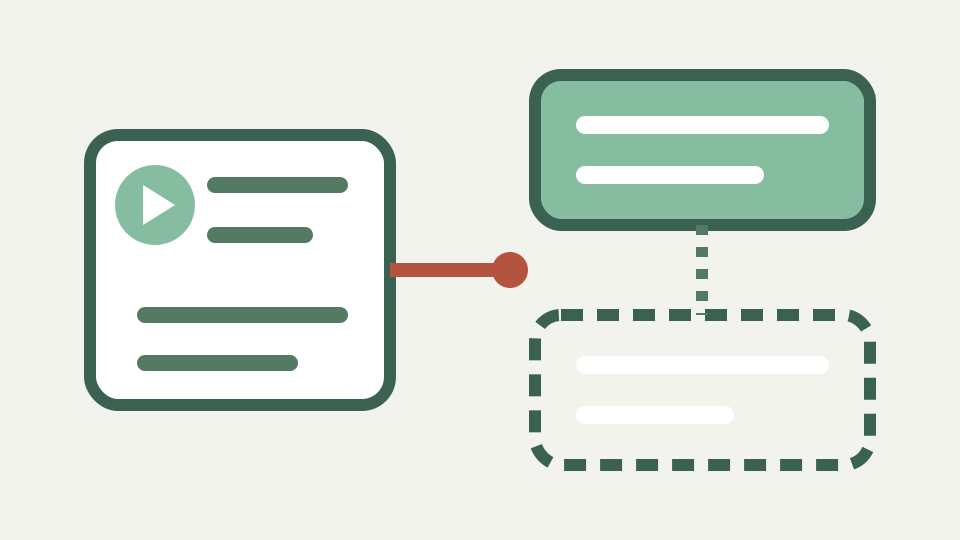
When you paste a video link into a chat app, a preview appears. This post explains the three metadata layers that make that possible, which one each platform reads and why public metadata exists in the first place.
Paste a link, see a card — the preview everyone uses and nobody thinks about
A rich card can contain a title, image and destination, but identical-looking cards may come from different metadata mechanisms. ToolAcre’s YouTube product implements one specific mechanism: a direct oEmbed JSON request. Compare that request with its normalized object rather than inferring more than the implementation proves. The request is made only after the user presses Fetch, so the article can distinguish local preparation from remote retrieval.
It does not reproduce a chat application’s preview pipeline. Explain the output from its own endpoint and normalized fields rather than reverse-engineering unrelated clients. A convenient assumption can turn one failed lookup into a misleading catalog entry. This keeps a title or image mismatch attached to the actual response instead of to an invented client-side cache story.
Open Graph is conceptual here; ToolAcre does not fetch watch-page meta tags
Open Graph commonly refers to meta tags placed in page HTML, but ToolAcre does not load the YouTube watch page or parse those tags. Any comparison here is conceptual, not a description of requests this app makes. No page markup means there is no second source to reconcile with the normalized record. A missing description therefore remains missing rather than being borrowed from an unrequested page.
Because no watch-page HTML enters the tool, Open Graph titles, descriptions and images neither supplement nor override the normalized oEmbed record. Record a failure as an observed response class, not a successful-looking fallback. This prevents a network refusal from being disguised as a metadata disagreement.
oEmbed — the endpoint that returns structured data and embed HTML on request
oEmbed is the implemented path. The browser asks www.youtube.com/oembed for a canonical watch URL plus format=json, then normalizes title, channel, channel URL, thumbnail dimensions, player dimensions and provider. The normalized shape also makes exports predictable when upstream JSON contains fields this tool does not promise.
Raw embed HTML is not displayed. ToolAcre independently creates a responsive privacy-enhanced iframe from the validated video ID, keeping generated markup under local source control. The exact request can be copied into a browser trace without adding account state. The iframe is a separate later browser interaction, not hidden metadata retrieval.
schema.org and JSON-LD are conceptual here; ToolAcre does not parse them
schema.org and JSON-LD describe other structured metadata approaches, but this app does not parse either from YouTube pages. Search-engine behavior and page annotations are therefore outside its evidence boundary. Retain observed values and dates separately rather than assuming historical state. A citation that needs those fields must consult an authorized source separately.
Mentioning these layers can orient a developer, but it must not imply that ToolAcre compares them or resolves disagreements among their fields. Conceptual comparison is not a feature checklist. There is no fallback merge operation that silently chooses one competing title over another.
Preview-app behavior and caching are outside ToolAcre’s implementation
Different preview applications may choose layers and caches differently, yet the repository contains no experiment across chat clients and no cache inspection. Claims about which app reads which layer would require separate cited research. No-store requests still depend on remote delivery and browser cache semantics. A clean ToolAcre run cannot prove what a third-party preview service will retain.
ToolAcre itself requests no cached preview card. It asks for current public oEmbed JSON with cache mode no-store, subject to browser and network semantics rather than a promise of historical freshness. Offline state, blockers or a managed proxy can still prevent the response.
Worked example: inspect ToolAcre’s oEmbed result, not three invented app previews
For a worked check, fetch one public video and inspect exported JSON. Map title, channel and thumbnail/player dimensions to normalizeOembed, then note absent description, views, duration, publish date and captions. Compare the canonical watch URL in the request with the video ID used by the local parser.
Do not invent three app screenshots or attribute their differences to a metadata layer without observing them. The implementation evidence supports only this one browser’s direct oEmbed result. Record failure as an observed response class. Invalid JSON is a response failure, not an empty field set.
What this does not cover — how to set these tags on your own site
Setting preview tags on another site is outside this product. ToolAcre neither authors Open Graph nor schema markup for the user, and it does not diagnose third-party cache refresh behavior. Its output remains tied to the current public response and exact input. A publisher must apply those tags in the destination site’s own workflow.
Its availability boundary remains signed-out public YouTube data: private, deleted and age-restricted records cannot be recovered, and metadata may fail through network, HTTP status or invalid JSON. A nominal URL is not evidence that bytes, metadata or permission must exist. No retry changes that access boundary.
Takeaway: ToolAcre uses only oEmbed for metadata
ToolAcre uses only oEmbed for metadata, alongside direct thumbnail files. Open Graph, schema.org and external caches are neighboring systems, not hidden steps. Retain observed values and dates separately when historical comparison matters. The result is a bounded public record, not a generic preview analyzer.
Before Fetch parsing is local; after it, eight image requests and one oEmbed request go straight to Google with credentials omitted, no referrer, no-store and followed redirects. Google sees the Origin header, and no ToolAcre server or proxy handles them. Those direct requests remain subject to Google’s signed-out limits and do not retrieve restricted material.