Images & photos · Image Metadata Privacy Tool
Stripping Metadata Is Not Enough: What the Pixels Themselves Reveal
· Why it matters
image-privacy privacy image-editing
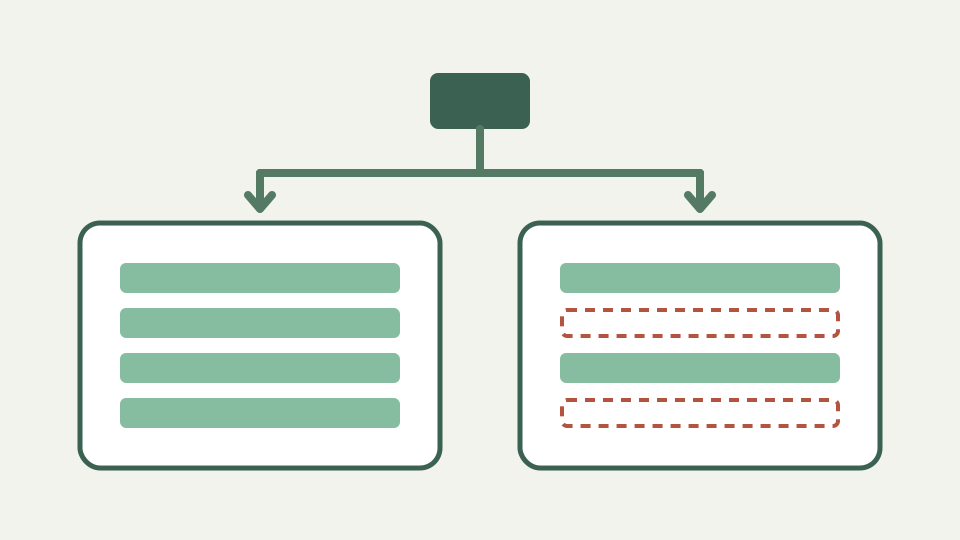
Removing EXIF, GPS and XMP closes the hidden channel, but the picture itself still shows faces, street signs, reflections, screens and shadows. This post sets honest limits on what a metadata tool can do and what habits fill the gap.
The stripped photo that still gave away the location — a landmark in the background, and why no metadata tool could have helped
A cleaned photograph can still identify a location through a landmark, street sign or distinctive room. No metadata parser can remove information that is visibly encoded in pixels while also promising not to touch those pixels. The tool’s value is narrower and useful: it closes supported container channels without suggesting that the visible scene has become anonymous.
What stripping actually removes — the metadata blocks and embedded thumbnail, and nothing in the image data
For JPEG the cleaner drops Exif, XMP, Photoshop/IPTC, comments and unrecognised APPn metadata while retaining rendering segments. PNG loses eXIf, text and time chunks; WebP loses EXIF and XMP. An EXIF-contained thumbnail leaves with its block. Compressed image data is copied verbatim, which is exactly why the visible scene remains unchanged.
What stays visible — faces, name badges, house numbers, licence plates, reflections in glass, and text on screens
Faces, badges, addresses, vehicle plates, documents, screens and reflections stay visible. So do tattoos, uniforms and the arrangement of a private interior. Review the full frame at normal and enlarged sizes, including backgrounds and reflective surfaces, before deciding whether cropping, blurring or withholding the picture is appropriate.
Inferred information — shadows and light for time of day, weather and clothing for season, and reverse image search for place
A viewer may infer time, place or relationships from weather, shadows, event signage or a sequence of images even when no explicit label appears. Those inferences depend on context and cannot be enumerated by an EXIF table. Separate the mechanical metadata check from a human review that understands the event and the audience.
Compressed image data remains outside this tool’s inspection
The workbook named sensor noise and recompression traces, but this repository neither detects nor removes them. The documented known gap is broader: data hidden inside compressed image data, including steganography, remains untouched. Avoid promising resistance to forensic linking when the implementation deliberately treats the image stream as opaque bytes.
A practical pre-share routine — crop or blur visible identifiers first, then strip metadata, then re-inspect the final file
A practical routine begins with the private original, makes any necessary crop or redaction in an image editor, exports a sharing derivative, inspects that derivative, removes its supported metadata and verifies the cleaned copy. Review the final pixels again because an export can change framing or add text, and upload only the newly downloaded file.
What metadata removal does not cover
This process is not legal advice, a policy certification or a guarantee of safety. It does not retract previous copies, clean unsupported containers or remove every non-pixel byte. Colour and density information may be retained to protect rendering, and an empty report means only that the bounded parser found no field it understands.
Takeaway: metadata removal is one step, not the whole job — use the Image Metadata Privacy Tool as the last check before sharing, not the only one
Metadata removal is one step, not the whole job. Use it as the final container check after visual editing, not as a substitute for scene awareness. The honest result is a derivative with named metadata blocks removed and pixels deliberately reviewed, rather than a vague claim that a photograph is completely safe to publish.