Video & subtitles · YouTube Thumbnail Downloader & Metadata Viewer
Why fetching a thumbnail and title beats opening the YouTube page itself
· Why it matters
youtube metadata workflow
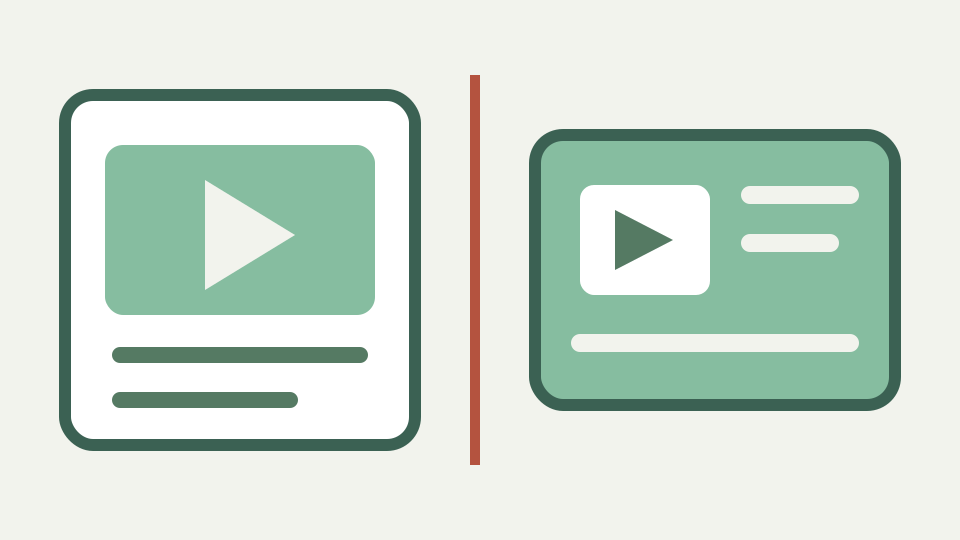
Opening a video page loads a player, scripts and recommendations. This post explains what a lightweight metadata and thumbnail lookup avoids, when it is the better choice and where opening the page is still necessary.
Fifty links to check and each one autoplays — the friction of using the page to read a title
A librarian may need only a stable video ID, current title, channel and representative image. Opening the watch page enters a full viewing interface when the task needs a small catalogue record. A focused lookup starts with a known schema, making it clear which observed values belong in the catalogue and which questions still require the source page. That schema makes dated records easier to compare field by field.
ToolAcre parses a supported watch, share, Shorts, embed, live or bare-ID input locally, then waits for Fetch. It probes eight JPEG candidates and requests one public oEmbed record for that identifier. The result is deliberately incomplete, not a miniature YouTube page. Its omissions must remain visible rather than being interpreted as negative facts about the video.
A watch page loads YouTube page code; this article does not invent a full traffic or cookie inventory
The repository does not measure request counts, cookies, recommendations or player initialization for every watch-page state. Those vary with location, consent, browser, account and experiments. A universal traffic inventory would be invented. The defensible contrast is narrower: a watch-page visit executes YouTube page code, while this lookup neither requests that page document nor runs its scripts.
That boundary still helps a school reviewing allowed hosts. The lookup names `i.ytimg.com` and `www.youtube.com`, but a smaller request surface is not offline processing. Google receives the direct requests, and managed networks may block either destination. Documentation should state that dependency rather than label the workflow local merely because no ToolAcre backend handles the ID. Host rules may need to allow metadata and the image CDN separately.
A lookup makes direct thumbnail and oEmbed requests without running YouTube page scripts
The thumbnail branch builds paths for five posters and three frame stills. HTTP 200 is insufficient: each body becomes a Blob, is decoded and measured. A larger name returning YouTube’s 120×90 fallback is marked missing, while undecodable bytes are an error. Eight requests therefore test independent image candidates; they do not download the video eight times.
The metadata branch separately calls oEmbed with a canonical watch URL and `format=json`. A JPEG can decode while oEmbed is refused, or metadata can succeed while an optional poster is a placeholder. Preserving those partial outcomes matters more than one overall success flag because each branch answers a different catalogue question and can fail independently. A catalogue can therefore retain a verified image without inventing the missing title.
Focus and speed — checking titles and channels in a list without leaving your workflow
The normalized record keeps title, channel, channel URL, provider, ID, thumbnail information and player dimensions in stable fields. Raw oEmbed HTML stays outside the contract. JSON, Markdown, CSV and text exports can populate matching catalogue columns without copying a rendered page. The benefit is controlled structure, not an unmeasured claim that every lookup is faster.
The response omits description, tags, views, duration, publication date, captions, chapters and comments. It also cannot show surrounding presentation. Research into chronology, audience response or description claims still needs the page or another authorized source. Turning omitted fields into “none,” or treating a poster as a summary, changes bounded evidence into an unsupported conclusion.
Worked example: catalogue public fields one video at a time
For twenty educational videos, a librarian processes each separately because there is no batch mode. They confirm the ID, export title and channel, choose `hqdefault` after verifying 480×360 dimensions, add the canonical URL and supply an access date. Each record stays tied to one visible input, one response set and one dated observation.
If item seven yields `mqdefault` but a proxy blocks oEmbed, the record keeps the image, ID and URL while marking metadata unavailable. If item twelve returns a 120×90 body for `maxresdefault`, another decoded candidate is selected. Neither failure contaminates the other records, and neither invites a guessed title or false high-resolution label. Recording the selected variant prevents a later editor from assuming every saved JPEG was maximum resolution.
What this does not cover — descriptions, comments, chapters and captions, which need the page or a different tool
Signed-out requests cannot recover private, deleted or age-restricted records, and a valid eleven-character ID grants no authorization. Disabled embedding may prevent oEmbed. The lookup also cannot retrieve historical titles or posters because predictable URLs expose current responses. Date important exports and, where permitted, preserve the downloaded file and source URL rather than expecting the path to remain unchanged.
Offline state, DNS controls, blockers and proxies can fail before HTTP; servers can refuse; oEmbed can return invalid JSON; and image bytes can be undecodable. A 200 response with a 120×90 fallback specifically means the requested larger candidate was not delivered. None proves the video never existed. The useful evidence is which mechanism failed and which independent branch succeeded. Retrying is justified for transport failure, but not as a way to reinterpret a decoded placeholder.
Takeaway: fetch what you need, no more — how the YouTube Thumbnail Downloader & Metadata Viewer reads public details without loading the page
Use the lookup to identify one public video, compare current thumbnail candidates, capture current title and channel, or create a compact export. Use the source page when context, chronology, captions, engagement or playback is the subject. Following a generated watch or embed link later enters a different presentation context and should not be confused with the lookup itself.
Its value is controlled scope. A retry may repair connectivity, and another thumbnail name may yield a usable image, but neither can create missing metadata or make a restricted record public. ToolAcre stores no lookup history, downloads no video or audio and offers no access bypass. The compact result remains trustworthy only when those boundaries accompany it. Save an access date externally when the lookup will support a durable catalogue or citation.