Developer tools · Unix timestamp converter
What the Z means: UTC, offsets and designators in ISO 8601 timestamps
· How it works
timestamps iso-8601 time-zones
Converters and APIs print instants as ISO 8601 strings, and the trailing Z or offset is the part people skip. This post explains the format piece by piece so you can read UTC and local output correctly.
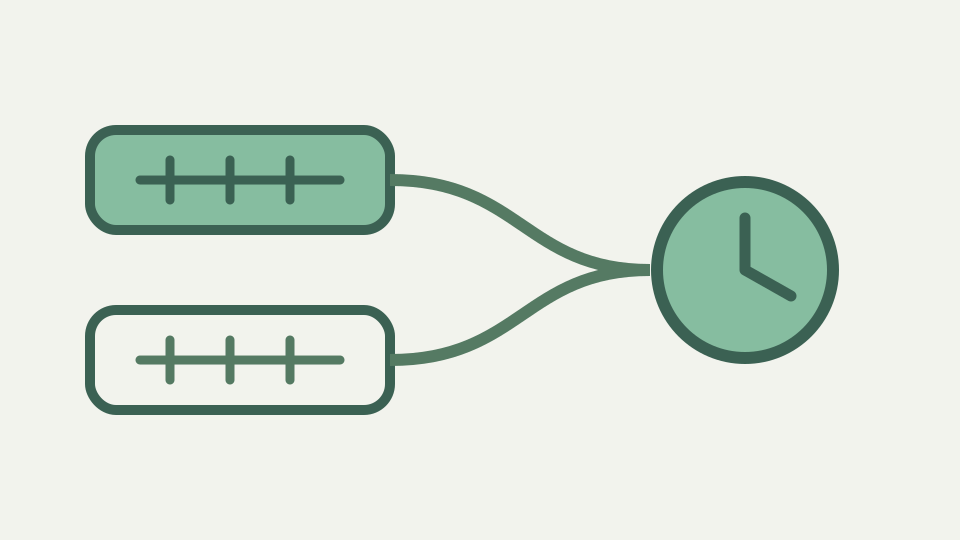
Two strings, one instant — 10:00:00Z and 12:00:00+02:00 side by side, and the reader who thinks they are two hours apart
`2025-02-03T10:00:00Z` and `2025-02-03T12:00:00+02:00` name one instant. The second string shows a wall clock two hours ahead and supplies the offset needed to subtract those hours. Reading only the hour field creates a fictional gap between simultaneous events.
ToolAcre passes both strings to Date and returns epoch seconds, epoch milliseconds and a canonical UTC ISO string. Equal numeric results are the decisive comparison. A changed clock face does not imply changed elapsed time when a designator at the end accounts for the difference.
The safe comparison procedure is to normalize each string to epoch milliseconds first. If those integers match, the apparent clock difference is representation rather than elapsed time.
The anatomy of an ISO 8601 date-time — date, the T separator, time, fractional seconds and the zone designator
The tool’s generated ISO value has a calendar date, `T`, hour-minute-second fields, a three-digit millisecond fraction and trailing `Z`. This exact shape comes from `toISOString()`. Input handling is broader because Date parses the supplied string, but the error message recommends an explicit value such as `2024-03-01T09:30:00Z`.
Separators make the parts legible; the terminal designator makes the instant determinate. Fractions refine the position within a second without changing the zone. When comparing API output, keep the final designator attached. Truncating a screenshot before it removes the information needed to map the clock to UTC.
Z for Zulu — why Z means UTC, its origin in military and aviation time zones, and why it is not the same as no designator
Within this implementation, `Z` is detected as an explicit zone and `toISOString()` uses it for UTC. The workbook’s military-origin account is not documented in the repository, so this article does not repeat it as sourced history. The operative fact is narrower and testable: a trailing Z prevents local-time assumption.
No designator is not another spelling of Z. ToolAcre sets `assumedLocal` for a date-time lacking Z or a numeric offset, then tells the user which browser zone supplied the interpretation. Replacing a missing suffix with Z changes the intended instant whenever the original clock was meant as local.
In this converter, Z marks the UTC form; its naming history is outside repository evidence
A suffix such as `+02:00` records the difference between the written clock and UTC at that instant. It does not identify a city. Many regions can share an offset, and a region can use another offset at another date. The string preserves the reading, not the political rules that produced it.
That limitation matters in recurring schedules. An API can faithfully report a past instant with `+02:00`, yet the suffix alone cannot calculate next winter’s 09:00 meeting. Epoch conversion needs only the supplied offset; future wall-time scheduling needs a named zone and rule-aware logic outside this panel.
Worked example: one epoch, two readings — the UTC value and the local value a converter shows, and confirming they name the same instant
Use epoch 1,738,577,600 seconds for this article’s check. The converter renders `2025-02-03T10:00:00.000Z`. A source string of `2025-02-03T12:00:00+02:00` converts back to the same count because its two-hour-later wall reading is balanced by the positive two-hour offset.
The browser-local row may display a third clock time. That does not create a third event; it is another formatting pass over 1,738,577,600,000 milliseconds. Verify identity with seconds or ISO, then use each labelled clock only for the audience whose zone it represents.
This equality can also become a regression fixture: parse both source strings and assert one epoch value. That test guards the offset arithmetic without pinning locale-dependent display prose.
The missing designator — a bare 2024-05-01T10:00:00 is ambiguous, and how different languages interpret it
The missing-designator case needs one refinement. A bare date such as `2025-02-03` is read as UTC under the ECMAScript rule implemented and tested here. A bare date-time such as `2025-02-03T10:00:00` is read as local and flagged. Calling both simply “ambiguous” would contradict the code.
The practical safe form for an interchange instant still includes Z or an offset. A local date-time can be intentional when entered through the panel’s `datetime-local` control, but copy its resulting ISO string before sharing it. That conversion records which instant the current environment derived from the wall clock.
A missing designator is not always ambiguous: this implementation distinguishes dates from date-times
ISO 8601 covers more notation than this converter demonstrates, but the repository does not provide parsers or tests for intervals, durations or week dates. Date acceptance can vary by platform for strings outside its reliable documented examples. This article therefore avoids presenting the panel as a general ISO grammar validator.
If an API contract permits a specialized date form, validate it with that API’s parser. ToolAcre’s date-to-epoch path is suited to explicit date-times and the local picker shape it emits. A successful Date parse proves this browser accepted a string, not that every standards-conforming consumer must accept it.
Durations, intervals and week dates are outside the accepted input demonstrated here
Read a timestamp all the way to its suffix before comparing the clock fields. Z anchors the written clock to UTC; a numeric offset supplies the arithmetic back to UTC; a zoneless date-time asks the browser to use local interpretation. These endings answer different questions despite similar-looking prefixes.
The converter labels its generated universal output and reports when it assumed local time. Use those notices as part of the result, not decoration. An hour value copied without its designator is incomplete evidence, while an epoch or canonical ISO row keeps the instant intact across readers.