Video & subtitles · YouTube Thumbnail Downloader & Metadata Viewer
JPEG and WebP thumbnails: the vi and vi_webp paths on i.ytimg.com
· Background
youtube webp image-formats
YouTube serves thumbnails in both JPEG and WebP. This post explains the two path conventions, why WebP was introduced, what the format changes for file size and quality and how to decide which one you need.
Two image formats for the same picture — the JPEG and WebP variants of a thumbnail
A poster name such as `hqdefault` appears in two URL families, but changing only the extension is wrong. JPEG uses `vi` and `.jpg`; WebP uses `vi_webp` and `.webp`. ID and poster role stay constant. The mapping provides format-specific addresses but guarantees neither optional-variant availability nor scripted access. Addressability, availability and cross-origin readability are separate facts. Logging the full URL prevents directory and suffix mistakes during debugging.
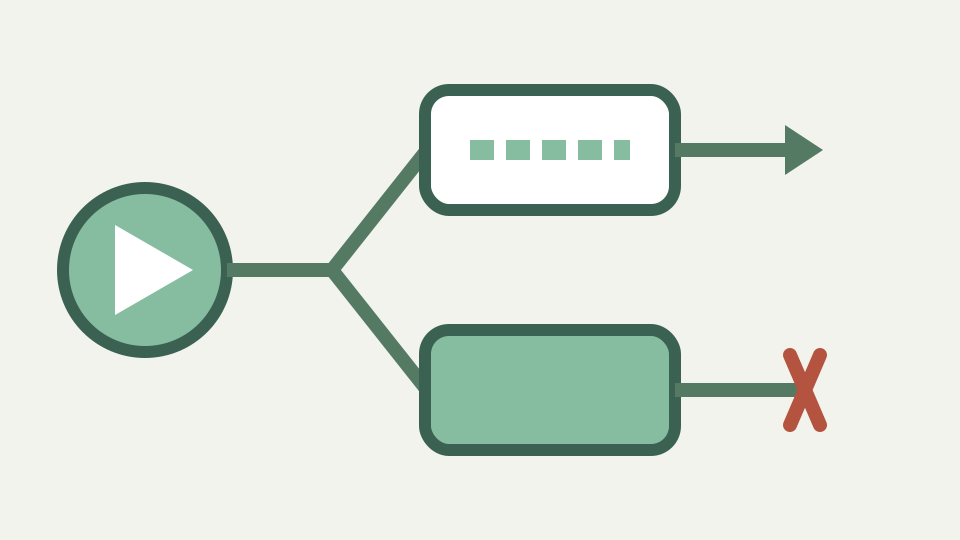
ToolAcre fetches JPEGs, checks status, creates Blobs, decodes dimensions and rejects 120×90 fallbacks for larger variants. It only constructs WebP links because `vi_webp` lacks the required CORS permission for that measured workflow. A link may open in a tab while in-app download remains disabled; that is a browser boundary, not a malformed format. DevTools can show the differing request outcomes without changing the policy.
JPEG: the long-standing default — universal support and the vi path
JPEG uses `https://i.ytimg.com/vi/VIDEO_ID/VARIANT.jpg`. Five poster names, `maxresdefault`, `sddefault`, `hqdefault`, `mqdefault` and `default`, plus frame stills `hq1`, `hq2` and `hq3`, produce eight candidates. Numbered files may show different moments; treating them as interchangeable can replace selected artwork with an arbitrary frame.
Each path needs verification. Requests may fail before HTTP, return errors, answer 200 with a 120×90 placeholder or contain undecodable bytes. ToolAcre retains a Blob only after response and pixel checks. Because genuine `default` is nominally 120×90, that size is accepted there but rejected for larger names. This beats trusting suffixes or every 200 response. Report the decoded dimensions with the selected filename.
WebP uses /vi_webp/; no unsupported size savings or support history is claimed
WebP uses `https://i.ytimg.com/vi_webp/VIDEO_ID/VARIANT.webp` and permits only five poster names. Requesting WebP `hq1`, `hq2` or `hq3` is a programming error, so no frame counterparts are implied. The repository proves no percentage savings, quality advantage or support history; those depend on actual encodings and clients, not a suffix.
CORS is the demonstrated limit. Top-level navigation can open a cross-origin image, while JavaScript cannot read its body without the remote header. ToolAcre therefore cannot decode dimensions, measure bytes, retain a Blob or offer its controlled JPEG download. Retrying cannot alter server policy, and no hidden proxy evades it. The honest control is a link. Opening that link still contacts Google directly.
Choose formats from actual workflow constraints, not invented quality measurements
Choose by the consuming workflow. A verified local file with a predictable name favors the readable JPEG Blob. A site may use a remote WebP link when clients support it, accepting a live `i.ytimg.com` dependency. An archive requiring stored bytes, checksums and dimensions cannot use a link-only result. Delivery, validation, retention and support decide the format.
Quality and size require measurement. Encoder settings and image content change compression, so extensions yield no responsible percentage. ToolAcre reports readable JPEG bytes and dimensions but invents no WebP figures. Compare permitted copies of the same poster role, record actual sizes, inspect them at intended display size and do not generalize one sample. Use the same rendering conditions for a fair comparison.
Worked example: compare exact paths without claiming measured savings
For ID `dQw4w9WgXcQ` and `hqdefault`, the addresses are `https://i.ytimg.com/vi/dQw4w9WgXcQ/hqdefault.jpg` and `https://i.ytimg.com/vi_webp/dQw4w9WgXcQ/hqdefault.webp`. Shared ID and role target corresponding representations. ToolAcre probes and decodes the JPEG, retaining non-placeholder bytes, but presents WebP only as a link.
If JPEG reports 480×360 and WebP opens in a tab, only navigation and JPEG measurement are proven. Scripted WebP reading remains unavailable; no size saving was measured. An authorized server pipeline may later record bytes and hashes for both, but those measurements belong to that pipeline and cannot represent other roles or videos automatically. Keep its report separate from the browser export.
What this does not cover — converting between formats, which is an image tool's job
Format conversion is outside ToolAcre. A permitted JPEG-to-WebP conversion creates a new encoding, not proof of matching YouTube’s `vi_webp` bytes. It cannot recover missing detail, and repeated lossy encoding may add artifacts. Record original URL and variant, preserve the source, choose destination-appropriate settings and separate modification rights from technical access.
Private, deleted and age-restricted videos expose no recoverable signed-out assets. Offline state, blockers, DNS controls and proxies can stop either family; optional variants may return errors or placeholders, and WebP may fail while JPEG succeeds. A valid ID and path prove construction only, not publication, availability, readability, persistence or reuse rights. Record failures per format rather than inferring equivalence.
Takeaway: exact paths and a CORS boundary
`/vi/` plus `.jpg` covers eight probed JPEG candidates downloadable from successful non-placeholder Blobs. `/vi_webp/` plus `.webp` covers five poster links and no numbered frames. CORS makes link navigation differ from app-level reading and download. Preserving that asymmetry is more accurate than offering a button unable to verify or save its promise. Interface labels should clearly distinguish a verified download from an external link.
Path diagnosis begins after local parsing: JPEG probes and WebP navigation go directly to Google, while no ToolAcre proxy changes either response. A JPEG row can supply status and decoded evidence; a WebP link exposes only the navigation outcome available under its CORS policy. oEmbed failures remain separate, stable paths may change, and saved files grant no rights. Directory, suffix, response access and the consuming workflow together determine usability; the extension alone does not.