Video & subtitles · YouTube Thumbnail Downloader & Metadata Viewer
The oEmbed standard: how a 2008 spec made link embedding work everywhere
· Background
youtube oembed web-standards
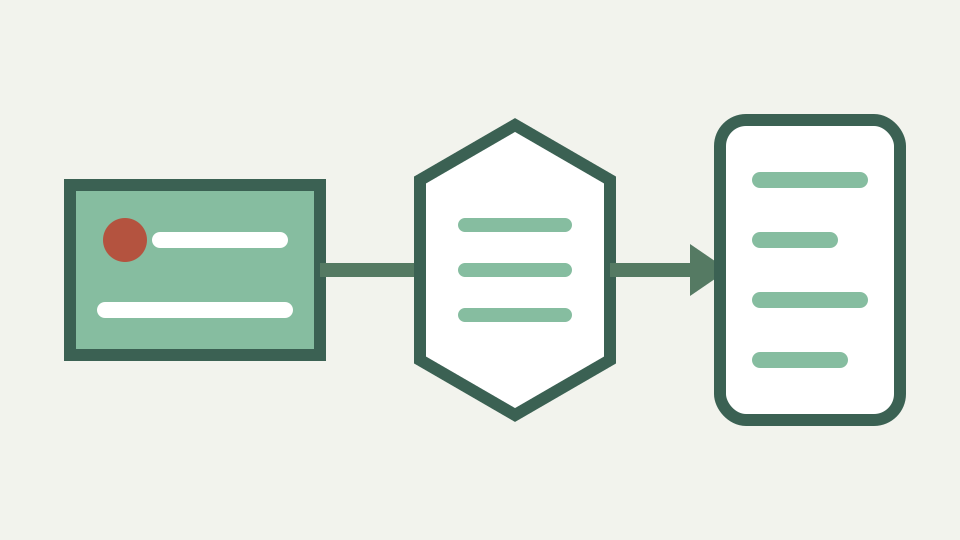
oEmbed is the quiet standard behind pasting a link and getting a player. This post covers its origins, the request-and-response contract, how sites discover endpoints and why it remains the simplest source of public video metadata.
Paste a link, get a player — the everyday magic that oEmbed made possible
Paste a supported YouTube link and ToolAcre returns a compact public record without parsing the watch page. The browser extracts and validates the video ID, then constructs one explicit oEmbed request. A developer can reproduce that destination and compare the upstream JSON with the displayed fields; no fragile page selector sits between the resource and its metadata.
The result is a current, signed-out snapshot, not a complete video record. It identifies the public title, author and thumbnail reference exposed through oEmbed. This boundary clarifies errors: malformed input fails locally, transport or HTTP can fail remotely, and an omitted normalized field is neither. Each condition has a different remedy.
The repository proves the current request contract, not an unsupported 2008 origin story
The endpoint is `https://www.youtube.com/oembed`. ToolAcre adds a `url` parameter containing `https://www.youtube.com/watch?v=VIDEO_ID` and `format=json`. Both are encoded as query data. Start times, playlist context and copied tracking parameters stay out of the metadata request, so only the validated video resource determines the lookup.
A `youtu.be` share link, standard watch link and supported embed link can yield the same ID and therefore the same oEmbed request. This normalization prevents input format from changing the result accidentally. It also creates a stable test assertion: one ID must always produce the known endpoint, canonical watch URL and JSON format.
The contract — a URL in, a typed response out, with fields for title, author, embed HTML and thumbnails
After a successful response, ToolAcre parses JSON into its own record: `videoId`, title, author name as `channel`, channel URL, thumbnail URL and dimensions, player dimensions, provider details and explicit omissions. Renaming upstream author keys gives JSON, Markdown, CSV and text exports consistent YouTube-oriented vocabulary instead of exposing an accidental wire format.
The missing-fields list says duration, views, likes, description, tags, upload date and captions were not obtained. It does not claim those values are empty on YouTube. That distinction matters in CSV and text, where an absent capability otherwise resembles a genuinely blank property. Numeric dimensions and optional strings are retained only as usable normalized values.
Endpoint discovery and registries are outside this implementation
ToolAcre does not discover an endpoint from a page `<link>` or consult a provider registry. The YouTube destination is a source constant. One parser, one identifier shape and one request builder cover the stated scope without fetching arbitrary pages or following endpoint information advertised by untrusted HTML.
Discovery would require parsing remote markup, validating advertised URLs and deciding which hosts may receive follow-up requests. The fixed endpoint avoids that extra surface and makes network review straightforward. If YouTube changes the service, the integration requires an explicit code change rather than silently following a destination that has not received the same review.
Cross-platform adoption claims are outside the verified evidence
The normalized record favors inspection and reuse. JSON preserves key-value structure, Markdown creates readable notes, CSV fits an inventory, and plain text fits tickets or research logs. Exporting the local model rather than raw oEmbed keeps names and omissions aligned across formats, so downstream users do not receive four subtly different interpretations.
oEmbed may return an HTML iframe fragment, but ToolAcre neither injects nor exports it. The app builds its own responsive player from the validated ID using YouTube’s privacy-enhanced host. Separating metadata from rendering avoids trusting provider markup and makes the player destination an auditable product choice rather than an opaque upstream string.
Suppose oEmbed supplies a title, `author_name`, `author_url`, a 480-by-360 thumbnail, player dimensions and provider details. ToolAcre adds the validated ID, maps author fields to channel fields, preserves usable dimensions and records unsupported properties. This deterministic projection can remain stable even when upstream adds keys the interface does not consume.
DNS failure, blockers or offline mode are transport problems. A non-success status is an HTTP problem; a successful status with malformed JSON is a parsing problem. None should create a partial invented record. Thumbnail probes remain independent, so metadata may succeed while one image fails, or JPEGs may decode while oEmbed is unavailable.
What this does not cover — Open Graph and schema.org, the other metadata layers that link previews read
oEmbed does not replace Open Graph, schema.org JSON-LD, the YouTube Data API or a preview cache. Those mechanisms have different fields, authentication and freshness. ToolAcre never fetches the watch document to compare them. Duration, publication time, statistics or captions require an authorized source, not guesses derived from thumbnail names or player dimensions.
A valid ID can still identify a private, deleted, restricted or nonexistent resource. Signed-out oEmbed cannot make it public. Titles, channel names and thumbnail references can also change under the same ID, so provenance needs an access date. An export records one lookup; it neither guarantees permanence nor grants permission to republish the returned material.
Takeaway: the implemented request and normalized response contract
Parsing and validation are local until Fetch. The browser then contacts `www.youtube.com` for oEmbed and `i.ytimg.com` for images, omitting credentials and referrer, requesting `no-store` and following redirects. Google still sees each request and its Origin header. No ToolAcre proxy hides the destination or bypasses signed-out access limits.
The contract is precise: normalize supported input to one ID, build the canonical query, require successful JSON, retain a documented field subset and mark omissions. Preserve whether failure occurred during input, transport, HTTP, parsing or access. That evidence makes exports useful without pretending a compact oEmbed response is a complete YouTube API.