Video & subtitles · YouTube Thumbnail Downloader & Metadata Viewer
Why hqdefault.jpg has black bars: YouTube's 4:3 era and the 16:9 switch
· Background
youtube thumbnails aspect-ratio
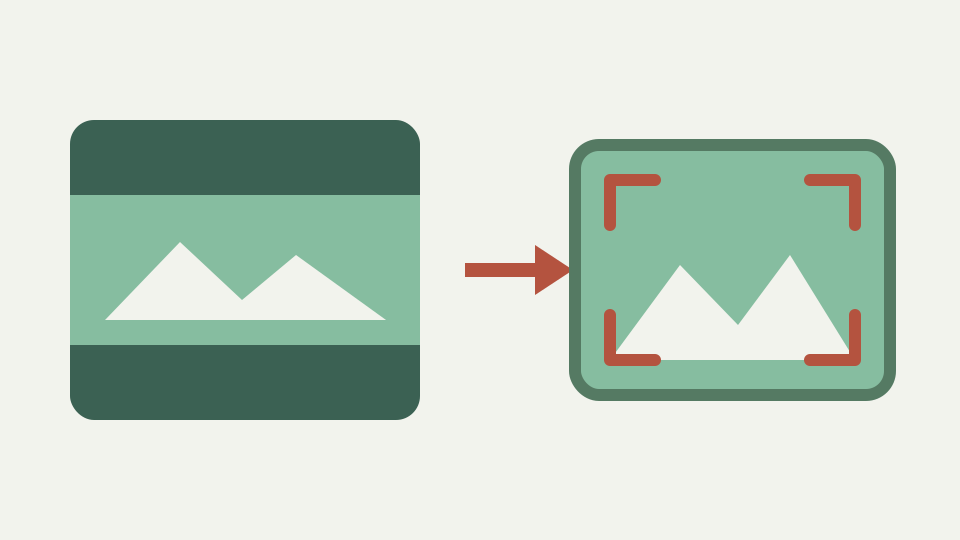
Some YouTube thumbnail sizes still carry letterbox bars. This post explains how the platform's early 4:3 player shaped its thumbnail sizes, what changed with widescreen video and why the old sizes remain for compatibility.
A widescreen video with a boxy thumbnail — the visible legacy of an older platform
A widescreen scene can arrive inside a 4:3 JPEG with horizontal bars baked into its pixels. In a 16:9 card, CSS cannot remove only those bars without transforming the image. `hqdefault` and `sddefault` are 4:3 catalogue canvases whose content may be letterboxed; stretching distorts the complete rectangle, while covering it crops pixels.
ToolAcre decodes readable JPEGs and reports actual dimensions with the variant’s aspect description. It neither crops nor reconstructs picture area. “Fit this thumbnail” can mean preserving bars, distorting the file or cropping pixels. Seeing 480×360 or 640×480 lets the user identify a source-image property before choosing among those actions. Downloading another copy does not alter baked-in bars.
Current 4:3 catalogue facts without unsupported platform history
`hqdefault` is nominally 480×360 and `sddefault` 640×480; both are 4:3. These current facts explain layout behavior but not when YouTube introduced the names, what motivated them or why they remain. Without supporting documentation, platform history is speculation, so live files and decoded dimensions are the evidence used here.
Nominal dimensions still require measurement. Optional `sddefault` may return 404, another error or a 120×90 placeholder under HTTP 200. ToolAcre decodes before accepting it. A measured 480×360 `hqdefault` establishes canvas shape, not visible bars; a 4:3 composition may fill the frame. Aspect ratio permits letterboxing but does not prove it. Inspect the pixels before scheduling any derivative work.
Current 16:9 variants without inventing a historical switch narrative
`mqdefault` at 320×180 and optional `maxresdefault` at 1280×720 are nominally 16:9. Both fit a widescreen slot, but the latter has sixteen times the pixel area. `mqdefault` may suit a small card yet soften in a hero; `maxresdefault` may have enough pixels but conflict with an overlay. Ratio answers only geometry.
`maxresdefault` may return 404 or a small placeholder, and cropping cannot create the absent source. Then `mqdefault` may be the only clean 16:9 option while 4:3 `hqdefault` offers more pixels. Choose lower detail, crop later or seek another authorized source. ToolAcre neither upscales `mqdefault` nor calls a placeholder maximum resolution. Destination size determines whether the tradeoff is acceptable.
Letterboxing inside a 4:3 frame — why hqdefault and sddefault carry bars while maxresdefault does not
Letterboxing fits a widescreen picture inside a narrower 4:3 canvas, leaving vertical space as bars. Stretching to 16:9 distorts bars and picture together. CSS `object-fit: cover` crops the outer rectangle and may retain baked-in bars. Precise cleanup requires inspecting pixels and defining a crop rectangle, not assuming a display property changes the source.
Cropping can also remove captions, logos, faces or intended composition. ToolAcre does not automate it; it supplies a verified JPEG Blob, and a separate editor performs permitted derivative work. Preserve the original, record source URL and variant, and save the crop separately. Successful public download does not grant modification rights, so review permission first. Include crop coordinates when exact reproduction matters.
Compatibility motives are outside the implementation; choose from observed files
Calling 4:3 paths compatibility artifacts from a particular era would invent a motive. The implementation establishes only current names, nominal sizes, aspect notes and public responses. Product code demonstrates present behavior, not a third party’s historical decisions. Dimensions that resemble older conventions do not supply that missing history.
Select observed files instead: decode `hqdefault`, `sddefault`, `mqdefault` and `maxresdefault`, check availability, compare composition and pixel needs, and record the source. Stable URLs may later serve revised artwork, so today’s file proves nothing about years past. Bars reveal no upload date; new videos may expose 4:3 candidates and old ones 16:9 posters. Date the observation rather than dating the format.
Worked example: crop is a user action, not a ToolAcre feature
A course page needs 960×540. `maxresdefault` returns a 120×90 placeholder, `sddefault` is unavailable, `hqdefault` is 480×360 with bars, and `mqdefault` is 320×180 without them. The clean file is too small; the larger one still misses the target and needs cropping. No supplied candidate meets every requirement.
With reuse and modification authorized, the editor preserves `hqdefault` and creates a separate 16:9 crop. They record its URL, 480×360 dimensions, access date and derivative filename, then test softness and lost content. If inadequate, they request a better source. ToolAcre delivered the original Blob; the editor made and approved the crop. The audit record should name that editor action explicitly.
Takeaway: bars are present in some current files; their history is not established here
A decoded 4:3 canvas does not prove bars until inspection, and visible bars prove no publication date, source-video ratio or platform era. `hq1`, `hq2` and `hq3` are frame stills, not poster crops, so substitution can change the scene. ToolAcre does not detect bar color, find a safe crop, assess faces or guarantee legible text. Check overlays at the final responsive breakpoints because a crop safe on desktop may hide its subject on mobile. Test both landscape and narrow portrait containers before approving the derivative.
A crop record should separate retrieval from editing. ToolAcre parses locally, then sends eight credential-free JPEG probes and one independent oEmbed request to Google; blockers, proxies, placeholders, decode failures or invalid JSON can leave partial evidence, and signed-out restrictions remain. The original response shows what arrived now, while crop coordinates, derivative filename and approval identify the later editorial act. Preserve both records when future reviewers must reproduce the final composition.