Video & subtitles · YouTube Thumbnail Downloader & Metadata Viewer
How the tool announces each request to i.ytimg.com and youtube.com first
· How it works
youtube privacy networking
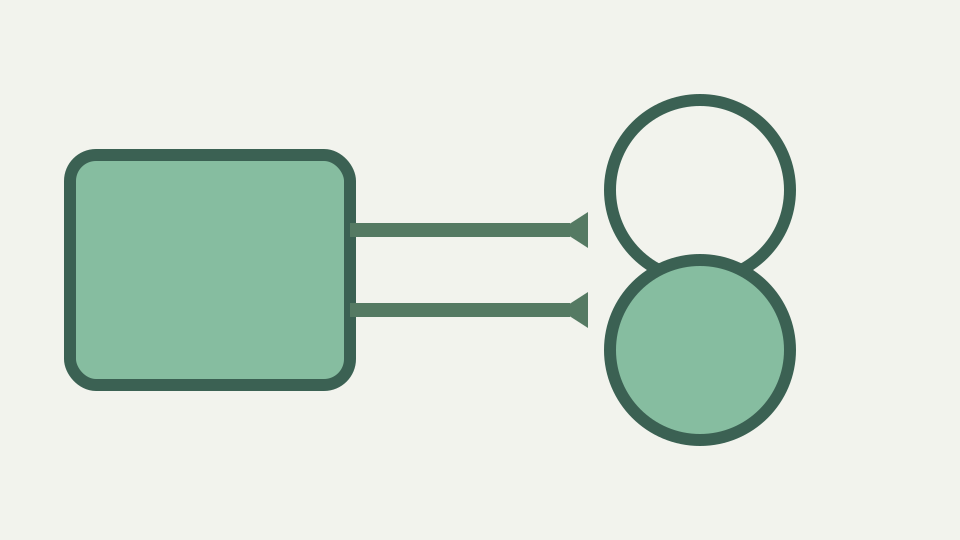
This tool contacts exactly two hosts, and it says so before it does. This post explains the announce-then-fetch pattern, why the two hosts are needed, what the registry records and how to verify the behaviour in your own browser.
Two hosts, named in advance — what the tool tells you before you paste anything
Before input is used, the page states that Fetch contacts i.ytimg.com for public thumbnail files and www.youtube.com for the public oEmbed record. Typing and parsing remain local browser operations until that explicit action. A privacy review can begin with the page idle, confirm that pasting a link creates no Google request, and then capture the precise traffic introduced by the button click. That before-and-after comparison tests the disclosure without requiring trust in a broad “private” label.
This is a bounded disclosure, not a claim that the whole website is offline. It tells a privacy-conscious teacher which tool operation crosses the network and gives two concrete hostnames to check. For a classroom workflow, the important choice is whether to perform the lookup at all; once Fetch is pressed, Google necessarily receives requests for the selected public video resources.
Why i.ytimg.com — the image host that serves thumbnails
The image host serves predictable JPEG paths for eight variants and WebP paths for five poster variants. After Fetch, the implementation makes one direct request for each JPEG candidate so dimensions and placeholder state can be measured. Eight image rows in DevTools are expected behavior, not evidence of repeated tracking calls or eight separate video downloads.
Those probes can meet 404, another error, a 200 placeholder or undecodable bytes. Offline state, blockers and managed proxies can prevent completion before an HTTP response arrives. Recording whether the browser received an HTTP response, a placeholder image or no response at all prevents a network policy problem from being mislabeled as an unavailable thumbnail size.
Why youtube.com — the host that answers for public title, channel and embed details
The metadata host receives one oEmbed URL containing the canonical watch URL and format=json. Its normalized result covers public title, channel, channel URL, thumbnail dimensions, player dimensions and provider, not private account data. The watch URL appears inside the endpoint query, so a network reviewer can match the requested ID to the pasted video without opening the watch page itself.
Metadata failure is independently reported for transport, HTTP refusal or invalid JSON. Private, deleted and age-restricted videos expose no signed-out record that the tool can recover.
The disclosure precedes Fetch; there is no separate announce event per request
The outline described an announce step before each individual request, but the product has no separate announce event stream. The user-facing disclosure and registered host catalogue exist before Fetch, while the click starts the documented requests. The honest interaction model is one informed action followed by a known request set, rather than nine pop-ups or invented per-request consent events.
That correction matters because observable behavior should not be embellished. Transparency comes from prior naming, a small network module and inspectable traffic, not from an invented notification emitted for every fetch call.
The manifest and catalogue record actual network semantics
The tool manifest marks localProcessing false, requiresNetworkAfterLoad true, and names the two destinations and trigger. The thumbnail catalogue and metadata module then define the actual paths, variants and response boundaries used by code. The manifest describes policy at product level, while the modules provide the concrete URLs a reviewer should expect to see on the wire.
Registry semantics therefore match the shipped implementation: this is one of the intentionally networked products, it uses no ToolAcre proxy, and it claims neither local-only processing nor storage of lookup results. That classification matters for inventories that separate browser-only converters from tools whose core result depends on a live third-party response.
Worked example: one lookup in the network panel — matching every request to the two announced hosts and finding no others
In DevTools, clear the request list before pressing Fetch. Expect one i.ytimg.com request for each of eight JPEG variants and one www.youtube.com oEmbed request, with no ToolAcre API endpoint carrying the pasted ID. Filtering by the extracted ID makes the nine expected entries easy to separate from fonts, analytics or unrelated page assets.
Inspect request options as well as names: the anonymous GETs omit credentials and referrer, request no-store caching and follow redirects. Google still sees each request and the browser-provided Origin header. If an extension cancels a row, preserve that status in the capture; it describes this browser environment rather than the existence of the remote asset.
What this does not cover — what YouTube's servers log on their side, which no browser tool can control
A browser panel cannot tell you what Google stores internally, and ToolAcre does not make that claim. It can prove the client request shape, direct destination, absence of its own proxy and fields its own code sends. This supports a transport audit, but retention periods and server-side correlation remain questions for Google’s policies rather than facts visible in the ToolAcre code.
Likewise, a clean run for one public video does not promise availability for restricted records. The tool performs no login, access-control bypass, media download or recovery of private, deleted or age-restricted assets. A syntactically complete thumbnail path is only a candidate address; the response body and signed-out access rules decide whether it yields a usable image.
Takeaway: named hosts, verifiable requests — how the YouTube Thumbnail Downloader & Metadata Viewer keeps its network use transparent
The strongest privacy description is narrow and testable: local parsing before Fetch, then direct public GETs to two disclosed services. This avoids both the false “fully local” label and vague language that hides remote dependencies. Save a dated HAR or request list when an audit requires evidence, because a later run may encounter changed assets, policy or network controls.
Use the Network panel whenever policy depends on exact hosts, because extensions and proxies can alter outcomes. The code and manifest establish intent; the recorded run establishes what this browser actually sent.