Developer tools · Text comparison
Diff a Config File Before You Deploy: Small Changes, Large Consequences
· Why it matters
text-diff configuration deployment
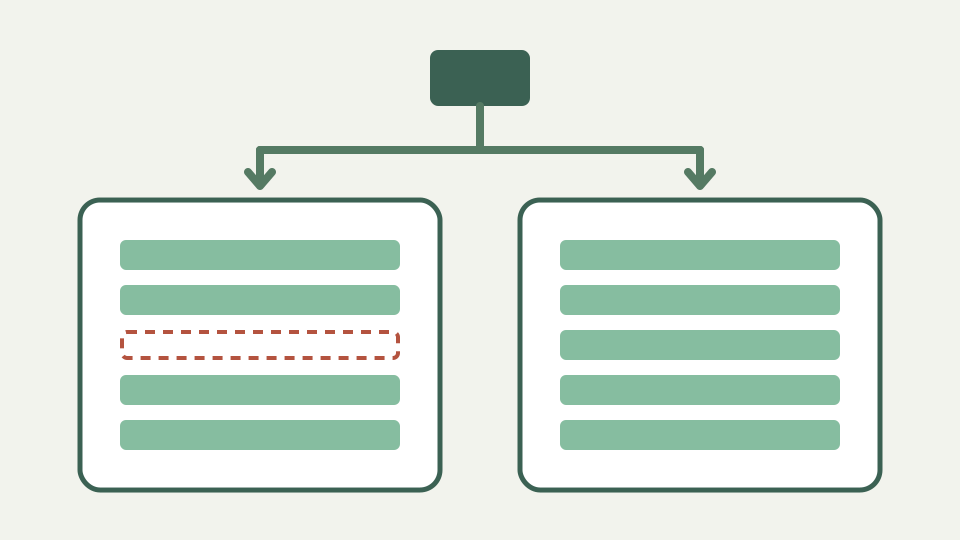
Argues for a quick line-by-line comparison of any configuration change before it goes live, with the common one-character mistakes it catches.
The one-character outage — opens with a missing semicolon or a swapped port that a quick comparison would have caught
A one-character configuration edit can have a large operational effect, but the diff can prove only that the character changed. A port, host, boolean or delimiter deserves deliberate review before deployment because copying a known-good file can carry unrelated edits along with the intended one.
Capture the actual deployed version and the candidate version through an approved process. Compare redacted text rather than retyping either side. Retyping creates a third version and weakens the evidence that the displayed rows describe what the deployment system will consume.
Why configs deserve a diff even when you only changed one thing — explains how editors, formatters and copy-paste introduce changes you did not intend
Even a supposedly single-setting change can include formatter output, line-ending conversion, copied comments or duplicated entries. ToolAcre normalizes CR, LF and CRLF while splitting, so its report focuses on line content rather than the physical ending bytes. That is useful but should be documented.
Start with Ignore case and Ignore whitespace off. The ordinary result is the closest line-text account. Only after reviewing it should you enable a normalization to diagnose noise, because each option deliberately makes some distinct original lines compare as equal.
What to look for in the result — lists typical findings: duplicated keys, changed defaults, stray whitespace in values, credentials pasted in by mistake
Check removed and added values, duplicated keys, changed comments that describe operational assumptions, and credentials accidentally introduced into the candidate. A changed line is not automatically wrong, and an unchanged line is not proof that the entire file is valid.
Pay attention to deletions without nearby replacements. Replacement edits appear as a removal and addition, while a missing row may represent an omitted required setting. The tool’s summary counts rows; it does not classify keys, defaults or mandatory fields for a particular configuration language.
Worked example: two versions of an .env file and an nginx block — shows a comparison where ignore-case hides a harmless key-case change and reveals a real host change
Compare an `.env` excerpt where `API_HOST=internal-a` becomes `API_HOST=internal-b`, then a server block whose port changes from 443 to 80. Each should produce a removed old row and an added new row. Verify those changes against the deployment request, not intuition.
The outline called a key-case change harmless, but the diff source cannot prove any configuration parser treats case that way. Keep case sensitivity enabled unless the format’s own documentation establishes equivalence. Ignore case is a viewing option, not a semantic guarantee about names.
Case changes are not proven harmless in configuration keys; review them with case sensitivity on
Environment files may contain tokens, passwords or internal endpoints. The reviewed Text diff call path computes locally and has no comparison request, but minimization still comes first. Replace secrets consistently on both sides or compare only the non-secret region needed for review.
Do not paste live credentials merely because an implementation is browser-side. Extensions, clipboard utilities and device policy lie outside the algorithm. When the material is regulated or production-sensitive, use an approved local diff and treat this route as a convenience for suitably redacted text.
Browser-side comparison avoids a processing endpoint, but secrets should still be redacted first
This comparison does not parse configuration syntax, resolve includes, identify shadowed keys or predict runtime behavior. A file can have no textual changes and still deploy differently because environment variables, defaults or dependent files changed elsewhere.
It also does not apply the candidate or roll it back. Use the format’s parser, application dry run and deployment controls after textual review. Line comparison is one gate that catches accidental edits; it is not a substitute for configuration validation or operational testing.
Takeaway: thirty seconds before every deploy — summarises the habit and how ToolAcre's Text comparison fits into it without login or upload
Make comparison a short, repeatable pre-deploy step: obtain authoritative states, redact, compare with strict options, investigate every unexpected row, then run syntax and application checks. Record the reviewed artifact hashes if your release process supports them, and link the result to the exact release candidate rather than a later working copy.
ToolAcre is useful when you need an immediate line account in a browser tab. Its narrowness keeps the evidence understandable: added, removed and unchanged lines, with original text displayed. The deployment decision still belongs to the system’s owners and verified rollout process, including tested rollback readiness.