Images & photos · Image Metadata Privacy Tool
Do Social Networks Strip EXIF? Why You Should Not Rely on Them
· Why it matters
exif image-privacy privacy
Large platforms generally remove metadata from the copies they show the public, but that is a policy rather than a guarantee, and it says nothing about what they keep or what messaging apps, email and cloud links pass through untouched. The reliable move is to strip before you share.
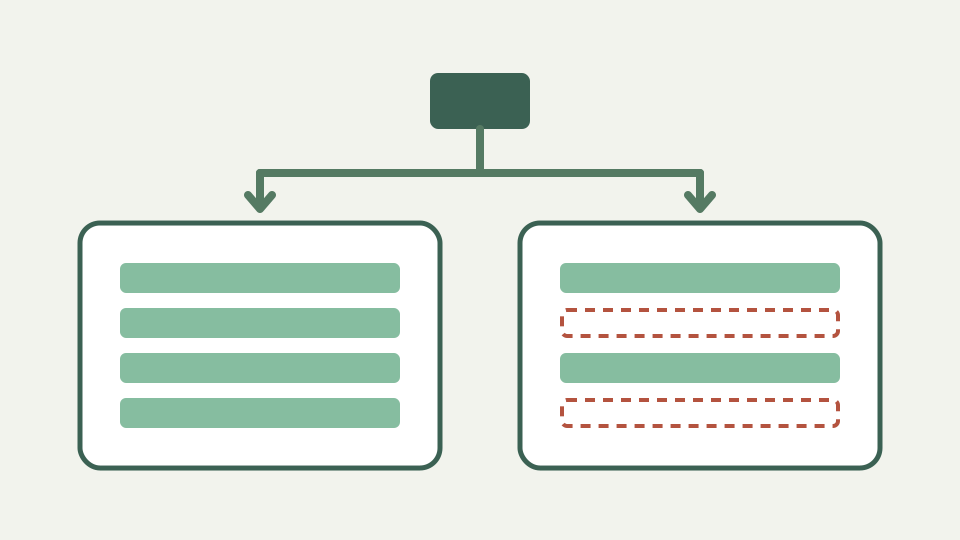
The same photo, five different routes — how one picture shared by chat, email, cloud link and social feed can arrive with or without its GPS tag
The same photograph can travel through a public post, direct message, cloud link, email and shared school group, and each route can handle the file differently. The repository contains no current platform-by-platform evidence, so this article does not claim which service strips or retains EXIF. It instead controls the only step that remains consistent: the bytes sent from your device.
Why a destination may transform a photo
A destination may resize, re-encode, make previews or preserve an original, but those are service decisions rather than properties of JPEG, PNG or WebP. A display copy with no readable EXIF does not establish what happened to the uploaded source. Platform policies and pipelines can change, so current destination documentation and a test upload are needed for any service-specific conclusion.
What destination behaviour cannot prove about your source
Downloading a transformed public image and finding no metadata proves only that the downloaded object lacks fields this parser reads. It does not prove the source was never retained, that every derivative is identical or that private message delivery follows the same path. Keep the claim tied to the exact file inspected rather than generalising from one visible copy.
Routes that deserve their own verification
Email attachments, shared storage links, messaging systems and publishing tools each need separate verification because some may transfer an original while others create derivatives. No universal rule follows from the route name. If a workflow matters, send a non-sensitive tagged sample, retrieve the actual recipient-visible file and compare it with the source.
Group sharing multiplies destinations
Group sharing multiplies both recipients and potential downstream routes. A member can save and resend the received file through another service whose behaviour was never tested. Removing metadata first avoids making privacy depend on every later participant, while still requiring a visual review for faces, signs, screens and other information carried by pixels.
Worked example: inspecting the same photo after each route — what a metadata report shows for each copy, described qualitatively
Use one sample photo and inspect it before sharing, then inspect the exact file recovered from each route. Record whether EXIF, XMP, text chunks or GPS fields remain, but avoid inferring server storage from the downloaded derivative. For the real photograph, create and verify a cleaned copy before it enters any route so those comparisons become a quality check rather than the privacy control.
What this does not cover — the platforms' own data practices and what they infer from the pixels; this post is about the file you hand over
Metadata removal cannot retract an original already sent, change copies stored elsewhere or hide clues visible in the image. The cleaner also covers only its documented JPEG, PNG and WebP blocks. It is not a guarantee of anonymity, platform deletion or legal compliance, and the source explicitly rejects claims such as “every trace” or “fully sanitised.”
Takeaway: make the platform's behaviour irrelevant — inspect and strip with the Image Metadata Privacy Tool before the photo leaves your device
Make destination behaviour irrelevant where you can. Inspect the source, remove the supported metadata blocks, verify the downloaded copy and share that copy rather than the library original. You may still test each platform to understand its pipeline, but the result no longer decides whether GPS, serial fields or editing metadata left your device in the first place.