Developer tools · JWT decoder
JWE Explained: Why an Encrypted JWT Has Five Parts and No Readable Payload
· Background
jwt encryption data-formats
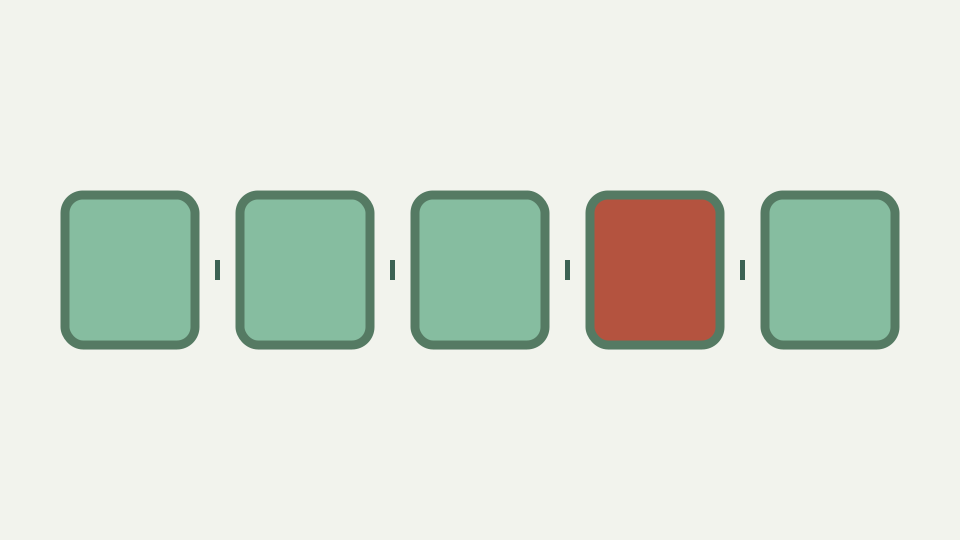
Some tokens have four dots instead of two and a payload that is not JSON. This post explains the JWE compact serialization, what each of its five parts holds, and why no decode-only tool can show its claims.
Four dots and a payload that is not JSON — the signs you are holding a JWE, not a JWS
Four dots and five segments indicate a different compact envelope from the familiar three-part signed form. Trying to parse its middle bytes as JWT claims produces nonsense because the content is ciphertext, not a base64url spelling of plaintext JSON.
ToolAcre checks segment count before decoding. Five parts trigger an INVALID_JWT message that identifies a JWE and explains why there is nothing for this decode-only route to show without a decryption key. That is a precise boundary rather than a vague parse failure.
The five parts — protected header, encrypted key, initialisation vector, ciphertext and authentication tag
The compact JWE parts represent a protected header, encrypted-key material, an initialization value, ciphertext and an authentication tag. Each has a distinct cryptographic role. Segment position alone does not make the second or fourth field a readable JWT payload.
A decoder can split and base64url-decode some bytes, but raw bytes are not decryption. Displaying them as text would create replacement characters or misleading fragments. The correct action is to identify the envelope and move to an authorized recipient implementation.
alg and enc — key management versus content encryption, and why a JWE header names two algorithms
A JWE header can contain `alg` for key management and `enc` for content encryption. These labels describe different operations. As with signed tokens, header values are inputs that must match recipient policy rather than permission for the token to select arbitrary algorithms.
ToolAcre’s three-part algorithm notes do not implement JWE processing, and the five-part branch exits before header parsing. The page therefore does not display or endorse particular encryption algorithms. Consult the recipient library and issuer contract for supported choices.
Content encryption keys — how a random key protects the payload and is itself wrapped for the recipient
Content encryption commonly uses a generated content-encryption key, while the encrypted-key segment conveys or derives that key under the recipient arrangement. The separation allows payload bytes to be protected with a content cipher while key-management policy determines who can recover the key.
This conceptual model explains why possessing the compact string is insufficient for plaintext recovery. The required recipient secrets and policy are not encoded as freely usable instructions. A public decoder cannot invent them and should never ask users to paste private decryption keys into a generic page.
When issuers choose JWE — claims that must stay confidential from the client or from intermediaries
Issuers may select encryption when claims must remain confidential from holders or intermediaries that can see a signed token. Whether that is the right choice depends on threat model, key distribution and operational requirements. Minimizing claim content can still be preferable to encrypting unnecessary data.
Encryption does not eliminate authorization, validation or metadata concerns. The recipient must authenticate protected content and apply token policy after decryption. A readable result obtained by an authorized recipient is not automatically acceptable for every service.
Why decoding stops at the header — the payload is ciphertext, so only the holder of the key can read it
Decoding stops at structure because the would-be payload segment is ciphertext. ToolAcre deliberately avoids presenting arbitrary binary as JSON and gives a specific message instead. This keeps users from interpreting gibberish as corruption in an otherwise valid encrypted envelope.
If you are the intended recipient, use controlled software configured with the appropriate key and algorithms. If you are not, the unreadable payload is the expected security property. No padding trick or alternate character decoder can replace decryption.
What this does not cover — nested JWTs that are signed and then encrypted, and JWE JSON serialization
Nested constructions can sign content and then encrypt the result, or otherwise combine layers under a defined profile. JWE also has representations beyond the compact five-part string. ToolAcre does not process those cases, and this article does not infer nesting merely from a header label.
Document which layer your system expects before troubleshooting. Otherwise a team may attempt signature verification on ciphertext or decode an inner token that has not been authenticated. Let the selected JOSE library handle ordering under explicit policy.
Takeaway: a decoder can only show what is not encrypted — the ToolAcre JWT decoder shows the header and payload of a signed token; a JWE's payload is unreadable by design
A decoder can show only what is not encrypted. ToolAcre reads JSON from the header and payload of three-part signed input, while five segments cause an explanatory stop. That distinction prevents a decode-only interface from pretending it has recipient capability.
Use segment count as a routing clue, not a trust result. Three readable parts still require signature verification; five encrypted parts require authorized decryption and validation. In neither case does visual output alone authenticate claims or grant access.