Video & subtitles · YouTube Thumbnail Downloader & Metadata Viewer
The 11-character YouTube video ID: what it encodes and why it looks random
· Background
youtube identifiers validation
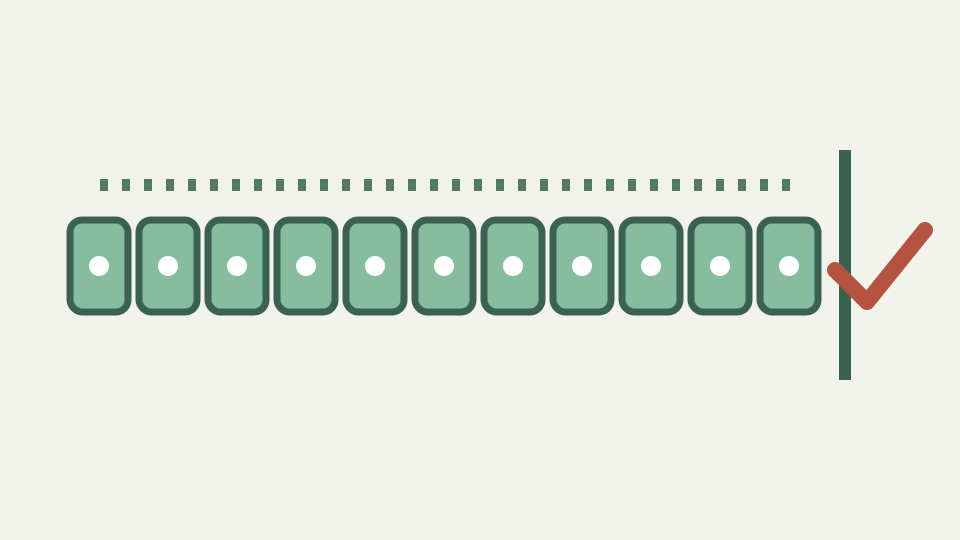
Every YouTube video ID is eleven characters from a 64-symbol alphabet. This post explains what that alphabet is, how much room it gives, why IDs are not sequential and how the ID is the key to every thumbnail and metadata request.
Eleven characters, every time — the pattern you notice after copying a few links
ToolAcre accepts a video ID with exactly eleven characters drawn from uppercase letters, lowercase letters, digits, hyphen and underscore. The rule applies to a bare token or one extracted from a supported URL. Checking locally catches truncated shares, copied punctuation and internal whitespace before constructing remote addresses or sending malformed candidates to Google.
Shape validation asks only whether text can occupy the tool’s video-ID slot. It does not prove YouTube allocated it, a video currently exists, or a signed-out browser may access it. Availability needs separate oEmbed and image evidence, and those endpoints may disagree because they expose different resources and failure modes.
The alphabet — letters, digits, hyphen and underscore, and its relationship to URL-safe base64
The alphabet works in paths and query values. Letters and digits need no special treatment, while hyphen and underscore avoid slash’s separator meaning and plus’s query ambiguity. Builders can safely place the validated token in short, watch, embed and thumbnail URL templates, although surrounding parameters still require proper URL encoding.
The characters resemble URL-safe Base64, but ToolAcre never decodes the ID or treats it as an integer. Do not append padding and search its bytes for a timestamp or channel key. Preserve the original case-sensitive string: lowercasing, Unicode normalization or numeric conversion can silently change the lookup target.
Shape validation does not prove random allocation, encoded meaning or practical capacity
Conceptually, validation is an anchored character class repeated eleven times: start, eleven allowed ASCII characters, end. Both anchors matter. Without them, a longer input could pass because it contains one matching substring. Exact boundaries make leading spaces, trailing punctuation and copied path text fail instead of being silently reinterpreted as an ID.
Counting the apparent alphabet across eleven positions describes possible shapes, not YouTube’s usable inventory. The code proves nothing about reserved values, allocation, retirement or collision handling. Capacity claims would add certainty the validator lacks. The defensible statement is simply eleven allowed positions, with the resulting token treated as opaque.
Opaque-looking IDs do not prove anti-enumeration intent
An irregular-looking ID does not prove randomness, and randomness would not provide authorization. Never protect a private note, paid resource or unlisted workflow merely with a hard-to-guess token. URLs can be copied, logged and retained in history. Access control must come from the platform and surrounding application, not the key’s appearance.
ToolAcre sends no login credentials and offers no bypass. Knowing a well-formed ID cannot expose a private, deleted or age-restricted video. Repeated requests cannot promote valid syntax into an allocated record either. Blockers, network policy and regional behavior can also stop a real public video, so failure proves only the observed request outcome.
The ID as a key — how thumbnails, embed URLs and metadata requests all hang off the same string
After validation, ToolAcre reuses the token for watch and short links, a privacy-enhanced embed, an oEmbed resource, five JPEG posters, three JPEG frames and five WebP poster links. Central validation prevents each builder from inventing a different rule or allowing a slash or oversized token into one URL family.
Start time and playlist context remain separate parameters. Builders preserve them only where supported; neither changes the ID. Extraction must not append `&t=90` or `&list=...` to the token. Users can therefore compare generated destinations around one stable key while playback context varies according to each link form.
Worked example: shape checks catch syntax errors, not existence
`dQw4w9WgXcQ` has eleven allowed characters and passes. Remove the final `Q` and ten characters fail; append another and twelve fail. Replacing one position with slash, period, space or a non-ASCII lookalike also fails. Trimming may remove surrounding input whitespace, but whitespace inside the token must never be repaired silently.
An invented eleven-character allowed string also passes shape validation, even with no assigned video. Fetch may then produce an oEmbed error, missing image, 120-by-90 placeholder or undecodable bytes. Those responses answer availability, not syntax. Status text should identify the failing layer so users know whether to correct input or investigate remote behavior.
What this does not cover — channel IDs and playlist IDs, which follow different patterns
Channel handles, channel IDs and playlist IDs use different forms and locations. ToolAcre does not force them through the video gate. A playlist-only URL lacks the key needed for thumbnail and oEmbed construction, so the useful correction is to open one video and copy that link rather than misclassifying unrelated identifier text.
URL parsing must locate IDs structurally, not scan for any matching substring. Watch URLs use the `v` parameter; short and embed links use defined path segments. Host checks prevent a hostile domain from merely mentioning `youtube.com`. Parsing establishes the candidate’s location; the same shape validator then checks only its token syntax.
Takeaway: one string unlocks the public assets — how the YouTube Thumbnail Downloader & Metadata Viewer works from the ID in your link
Extraction and validation stay local until Fetch. Metadata and image requests then go directly to Google with credentials and referrer omitted, `no-store` requested and redirects followed. Google still sees the request, network address and Origin header. No ToolAcre proxy verifies IDs, stores lookup history or supplies authenticated fallback access.
Use the gate precisely: preserve case, require eleven allowed positions, and separate extraction from validation. Then report remote evidence independently for metadata and each thumbnail. This layered result is stronger than claiming an ID reveals age, owner, chronology, security or existence. The opaque key links requests; only current responses describe public availability.