Developer tools · Text comparison
From diff to patch: How Text Differences Became Shareable Changes
· Background
text-diff patches software-history
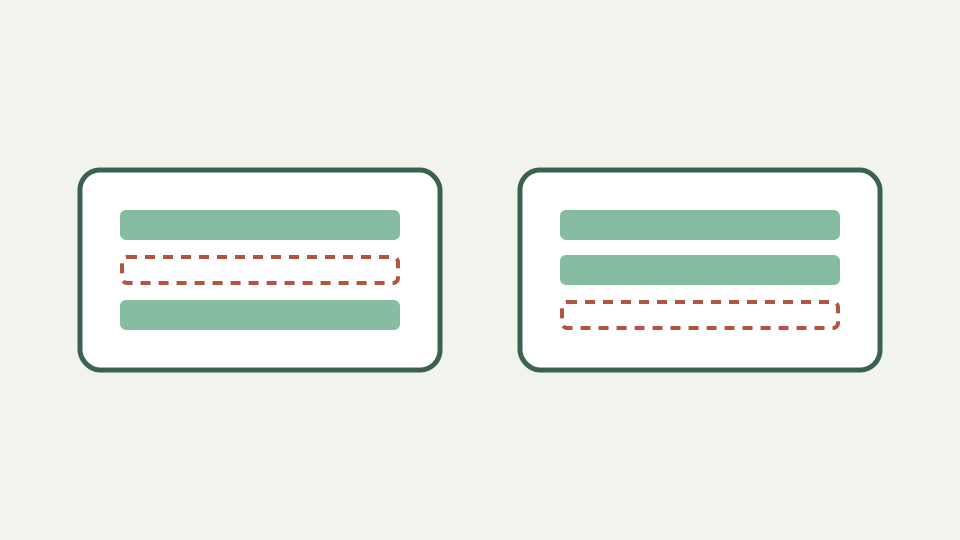
Tells the story of patch, the program that turned diff output into something you could apply, and explains why context lines and offsets make patches robust.
Sending a change by email in 1985 — opens with the problem patch was built to solve: distributing fixes without shipping whole files
Sharing a change can be more compact than sharing two complete states, but the historical story in the workbook includes dates and motives that are not documented by ToolAcre’s repository. This article does not turn those prompts into facts from memory.
What the source proves is present-day behavior: two strings become ordered rows, and those rows can be downloaded as a marked text file. That is enough to explain the boundary between seeing a difference and applying one without inventing historical authority.
Historical email and date claims need primary sources outside this repository
The requested account of named authors and early patch development needs papers, manuals or archives. None appears in the source list, so those details are deliberately omitted. A familiar attribution is still an unsupported claim when the contract requires repository-grounded writing.
This omission demonstrates the authoring rule rather than weakening it. Readers receive an exact description of ToolAcre and a clear signal that a separate sourced history is needed. Technical confidence should rise when evidence boundaries are visible.
Larry Wall and patch history are omitted without cited primary material
Surrounding equal rows help a person understand where changes belong. The browser view can hide the middle of long unchanged runs while retaining three rows around changed regions. Skip markers report how many equal rows were hidden.
Download behaves differently: it serializes the complete underlying diff, not the collapsed display. It emits no hunks or context ranges. Therefore the exported context cannot guide a general patch applicator in the way the workbook describes for other formats.
ToolAcre visually collapses context but exports every row without hunks
Fuzz, offsets and reject files are outcomes of applying patches to states that may have drifted. ToolAcre has no apply command, common-ancestor input or target file loader. Its source cannot produce those messages because it never attempts the operation that would need them.
Use the browser output to inspect a proposed change, then use version control or a dedicated patch program for application. Keeping those actions separate prevents a downloaded review artifact from being mistaken for an executable change package.
Fuzz, offsets and rejects belong to patch applicators, which this tool does not implement
Compare `mode=preview` with `mode=live`, download the result, and inspect the space, minus and plus markers. The file records the textual transition as ToolAcre aligned it. Save it beside a review note if that is useful for the workflow.
Stop before claiming it will apply to a modified configuration. The export has no hunk coordinates and the repository has no parser consuming it. Application compatibility must be demonstrated with the intended downstream tool, not inferred from the filename.
Worked example: download a comparison, then stop before any apply claim
Modern repository and mailing-list workflows may use patch formats, but documenting their lineage requires external sources and tool-specific behavior. This article does not generalize from ToolAcre’s labels to `git format-patch`, commit metadata or e-mail transport.
When those topics matter, consult the relevant manuals and generated artifacts. The browser tool can still occupy a preliminary role: compare two candidate states and review the actual rows before creating a formal patch through the authoritative system.
Modern mailing-list lineage needs external evidence
A two-text comparison does not create authorship, commit identity, merge history or an apply policy. It reports additions and removals under selected normalization options. A downloaded file cannot restore metadata that never entered the tool.
Merge conflicts are a separate problem because they require at least a base plus two descendants to distinguish independent edits. ToolAcre accepts only original and changed text, so it cannot determine which branch should win or synthesize a merged result.
Takeaway: a diff is only half the conversation — summarises how diff and patch pair up, and where a quick browser comparison like ToolAcre's fits before you commit
A diff is an account of difference; a patch application is an action against a target. ToolAcre completes the first and offers a portable marked stream, then stops. That boundary is visible in both the UI controls and source imports.
Review the change here when a quick local view helps, but generate and apply production patches with a system whose format and target checks are documented. Honest handoffs are safer than treating similar punctuation as proof of interchangeable capabilities.