Text & everyday tools · QR & Barcode Toolkit
QR codes outlive campaigns: choosing a URL that still works in five years
· Why it matters
qr-code printing usability
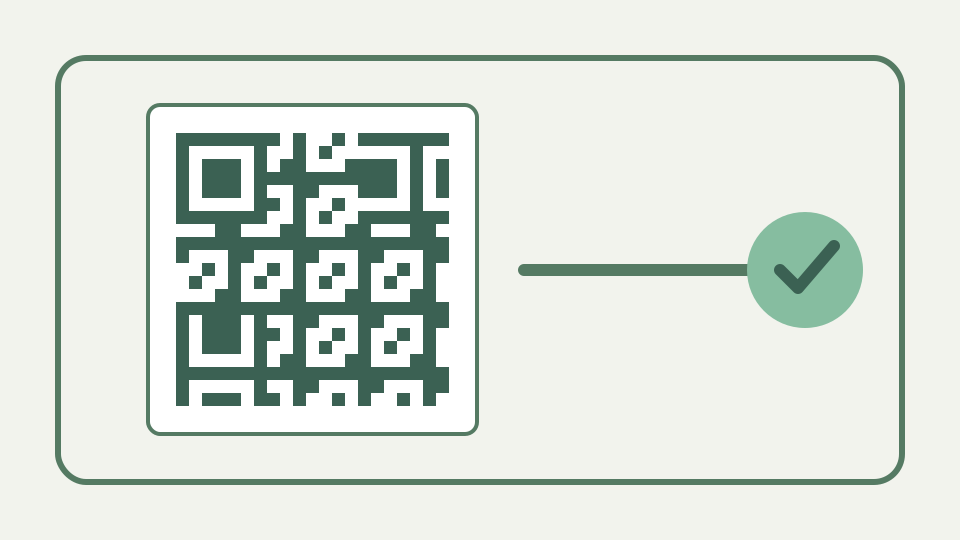
Printed codes stay in the world long after a campaign ends; this post shows how to pick destinations you control and how to keep a code alive when content moves.
The exhibit label pointing at a dead page — how a code cast in metal outlives the site structure behind it
A metal label can remain readable long after a content-management path changes. The QR matrix still decodes correctly in that situation; the failure is the destination, which is why URL ownership must be decided before permanent artwork is approved.
Treat a dead destination as a web-maintenance incident, not a reason to increase correction or regenerate identical modules. Decode the label, request the URL and record the HTTP result. If the matrix yields the expected address but the server returns an error, replacing the QR with the same payload changes nothing. Restoring the route or redirect fixes every existing label at once.
Why link rot hits QR codes harder — no one can edit a printed square, so the URL is the only lever
Printed modules cannot be edited after installation, so the encoded text is fixed. A web redirect is the remaining lever: a stable address can keep serving or forwarding requests even when the underlying page, platform or file changes.
The fixed-payload property makes link rot more visible than in editable digital navigation. A website menu can change links centrally, but each plaque is an independent frozen copy. Inventory long-lived QR locations and associate them with a route owner so a content migration includes redirects for physical entry points that analytics or site crawlers may not reveal immediately.
Choose a URL you own — your domain, not a shortener or a platform page that can vanish or change terms
Prefer a domain whose renewal and DNS you control over a third-party shortener or social profile. Control does not guarantee permanence, but it gives your organisation the ability to repair routing without replacing every physical label.
A domain you control provides repair authority, not immortality. Renewal failure, DNS changes and organisational ownership transfers can still break it. Avoid a free shortener whose policy can change without your institution, and assign responsibility for the domain in the same preservation plan as the exhibit label. The code’s lifespan is only as useful as the authority maintained over its decoded address.
Design the path for permanence — short, lowercase, no dates or campaign names, and a redirect you can repoint later
A short, readable path is easier to document and may produce a less dense matrix than a long campaign URL. Avoid embedding temporary tracking parameters or a dated publishing structure when the physical object is intended to last.
Short paths reduce bytes and are easier to read aloud or type when scanning fails. Lowercase avoids accidental case-sensitive routing differences; removing dates and campaign names prevents the path from becoming misleading after content changes. None of those naming choices is enforced by QR Code Generator. They belong in the URL design review before the exact string is frozen into print.
Static code, movable destination — using a stable path on your own site as the encoded URL so the code never has to change
A static code can therefore lead to a movable destination when it stores a stable path on your server. The movement occurs in your redirect configuration, not inside the QR symbol, and the toolkit has no dynamic-code service.
The redirect target should be documented independently of the web server configuration. Record that `/exhibit/12` currently forwards to a collection page, who approved it and which physical labels contain it. A future curator can then repoint the route deliberately instead of deleting an apparently unused redirect that still serves objects in galleries, storage or printed catalogues.
Worked example — planning a permanent /exhibit/12 style path, encoding it, and documenting where it redirects
For an exhibit, reserve a path such as /exhibit/12, document its owner and current target, then encode that stable address. Scan the printed proof and separately test the redirect, because matrix quality and web routing are distinct checks.
Test the complete chain in the worked example: decode `/exhibit/12`, confirm the organisation’s host, follow the redirect on a phone and verify the final page. Then test a direct request after any site migration. A successful scan proves matrix readability only; the final content check proves that routing and mobile presentation still meet the label’s purpose.
What this does not cover — commercial dynamic QR services and their analytics
Commercial dynamic-code dashboards and their analytics are outside ToolAcre. The same is true of domain registration, redirect hosting, uptime monitoring and institutional record keeping needed to preserve a link for years.
A commercial dynamic service is another way to move a target, but it substitutes provider account continuity for your own route management. This article does not compare dashboard features or retention because ToolAcre supplies neither. The relevant boundary is operational: static QR plus a controlled web redirect achieves destination changes without making the printed matrix itself dynamic or editable.
The takeaway — decide the URL carefully once, then generate the code in the QR & Barcode Toolkit with nothing in between you and your visitors
Choose and document the permanent URL first, then generate the static matrix and archive both payload and artwork. QR Code Generator reproduces the exact address you enter; keeping that address useful is an ongoing publishing responsibility.
Archive payload text, vector artwork, route documentation and a dated scan result together. The exact string allows regeneration if the physical code is damaged, while the redirect record preserves intent when the site changes. ToolAcre can reproduce the matrix deterministically from the same settings; it cannot preserve institutional knowledge about why that path exists or who must maintain it.