Text & everyday tools · QR & Barcode Toolkit
Static vs dynamic QR codes: why some free QR codes expire or track scans
· Why it matters
qr-code privacy browser-processing
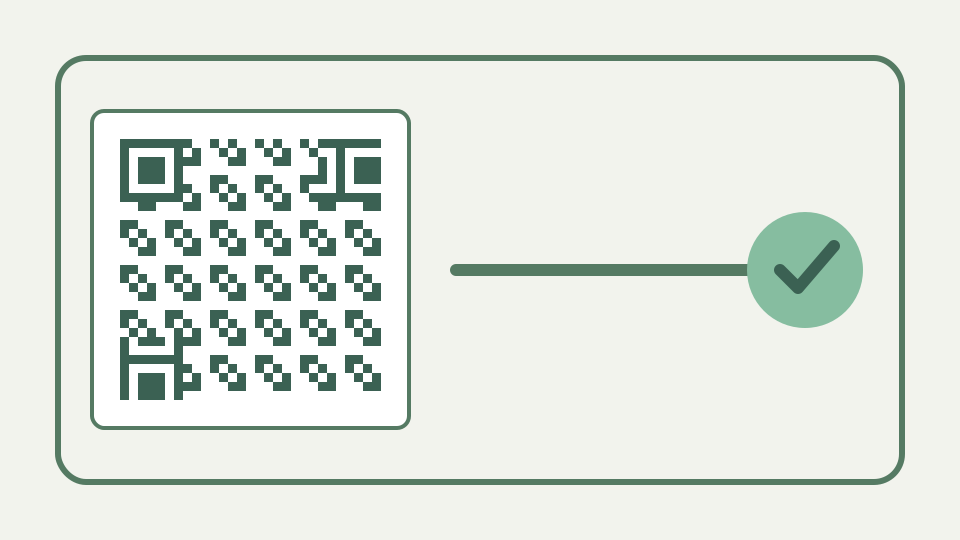
Explains the business model behind 'free' dynamic QR codes — a redirect through the provider's domain — and why a static, locally generated code cannot expire or report your customers' scans.
The flyer whose QR code now shows a paywall — how a code that worked at launch can stop resolving when a subscription ends
A printed square does not acquire a subscription clock by itself. A code can appear to expire when it encodes a provider-controlled redirect and that redirect stops forwarding after an account or campaign changes.
You can diagnose the architecture by decoding rather than judging the artwork. If the result is a provider domain followed by an opaque token, the service controls the next hop. When that account is disabled, the matrix can still decode perfectly and the intermediary can still load a paywall or error. The symptom distinguishes service dependency from print damage: the phone recognises a URL, but the redirect no longer reaches the expected destination.
What a dynamic code really encodes — a short URL on the provider's domain, not your destination
A dynamic service commonly places its own short address in the QR payload, then decides where an HTTP visit goes. That indirection permits later destination changes, but it also makes the printed code dependent on a domain and service you do not control.
The provider can change the redirect target because the printed payload stays constant. That is the feature behind “editable” QR marketing, not a special matrix type. It also means migrating away requires either keeping the original provider route alive or replacing every print. Before committing permanent artwork, document the decoded intermediary address and the contractual conditions under which it continues forwarding.
A redirect operator can observe requests, but exact analytics fields depend on that service
The redirect server necessarily receives a request and can observe ordinary connection metadata, yet this repository cannot verify which fields any named service stores or reports. Read that provider’s current policy rather than assuming a fixed analytics package.
At minimum, a redirect receives an HTTP request needed to forward the visitor. Beyond that, fields retained, aggregation, location inference and reporting are policy and implementation questions for the provider. A scan-count dashboard is evidence that some request processing occurs, but it does not establish every item in an imagined log. Review current documentation and contracts for the particular service.
What a static code encodes — your destination directly, readable by any camera without anyone's server in between
ToolAcre’s static generator encodes the exact text supplied and contains no redirect service. The matrix itself has no expiry setting, account lookup or scan counter; the destination can still fail if the encoded site disappears.
A static ToolAcre code contains no account identifier or update channel. If it stores `https://example.org/menu`, that is what any decoder returns tomorrow as well. The code itself cannot report a scan. Availability then depends on the destination, DNS and hosting rather than a ToolAcre redirect, so “cannot expire” should be understood as no encoded subscription gate, not guaranteed website uptime.
When dynamic codes are genuinely useful — changing destinations after printing and legitimate campaign measurement
Dynamic redirection is useful when a destination must change after printing or when a campaign deliberately needs managed measurement. The trade-off is continuing operational dependence, not a flaw in the QR encoding format.
Dynamic routing earns its complexity when posters must survive destination changes or a campaign requires managed measurement. The operational checklist should include account ownership, renewal, data policy, export options and a shutdown plan. If none of those benefits is required, direct encoding removes a moving part and gives the audience a recognisable destination in the camera preview.
Worked example — decoding a dynamic code's URL with a camera to see the intermediary, then generating a static equivalent
Scan or decode an existing campaign code and inspect the URL before opening it. If it points through an intermediary, compare it with a new ToolAcre code containing the final URL directly; the matrices differ because their payload strings differ.
For a worked inspection, scan an existing dynamic code without opening it and record the previewed host. Then make a ToolAcre code from the final destination and preview that one. The first reveals the intermediary; the second reveals the destination directly. Do not claim the static matrix matches or replaces provider analytics—it deliberately removes the service that supplied those features.
Worked example: inspect the decoded intermediary URL, then create a direct static payload
You can also operate a stable redirect on a domain you control, but hosting, logs and analytics then become your responsibility. ToolAcre creates the QR image only and does not configure or audit that server-side layer.
A redirect on your own domain preserves destination flexibility while keeping the visible host under organisational control. It still requires server configuration, logging decisions, monitoring and maintenance. ToolAcre neither creates that redirect nor counts requests. This division is useful: the QR remains a static encoding artifact, while change and analytics live in an ordinary web route your team can audit.
The takeaway — for anything printed, a static code from the QR & Barcode Toolkit encodes exactly what you typed and depends on nobody
For a fixed destination, encode a short address you control directly and archive the payload with the artwork. The resulting static code has no ToolAcre account dependency, while the continued availability of the destination remains yours to maintain.
Archive the exact payload with the print source and test it before release. For direct codes, monitor the destination; for managed codes, monitor both intermediary and destination and keep account ownership current. The reliable choice is not “static always good” or “dynamic always bad,” but selecting only the dependencies whose ongoing cost and data flow solve a real requirement.