Documents · Freelance Invoice Tool
Why a PDF Is Still the Right Format for a Freelance Invoice
· Why it matters
invoice pdf file-formats
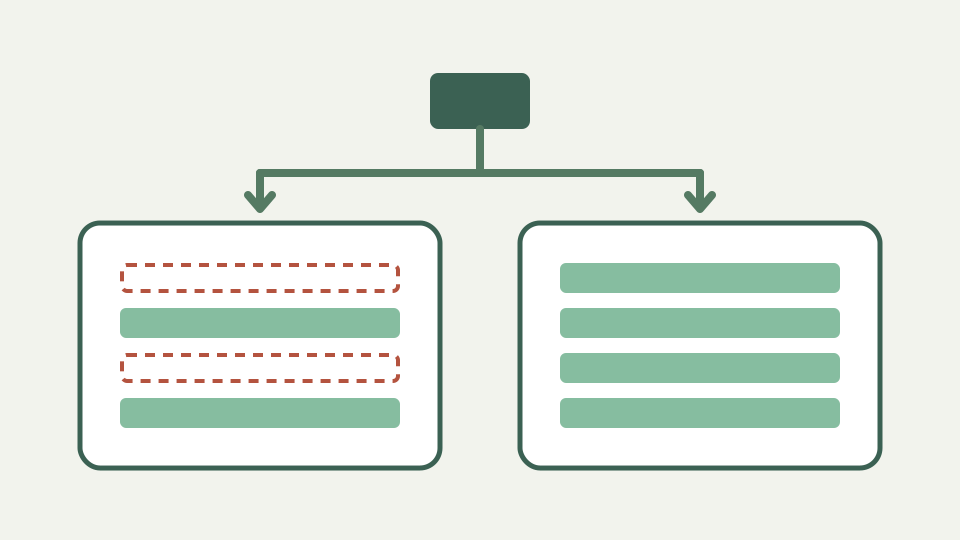
Clients can edit a Word invoice, break a spreadsheet's formulas or fail to open either. This post explains why a fixed-layout PDF remains the expected format for invoices, where it falls short, and how structured e-invoicing fits alongside it.
The client's system changed your total — what goes wrong when an invoice arrives as an editable file
An editable spreadsheet can recalculate when a formula or cell changes, and a word-processing layout can reflow on another system. Sending the final record as a separate PDF avoids asking the recipient to open the working source. Keep the source privately if you need to revise and regenerate.
Fixed layout, everywhere — why a PDF looks and prints the same on the client's phone, laptop and archive system
PDF describes a page rather than exposing spreadsheet formulas or editable document styles. This writer creates A4 or Letter pages with positioned text, rules and optional JPEG imagery. A viewer can still differ at the margins, so inspect and print-test important documents instead of promising perfect identity everywhere.
Hard to alter casually — not tamper-proof, but a clear record of what you sent compared with a live spreadsheet
A PDF is not tamper-proof, signed or access-controlled merely because it is a PDF. Its practical advantage is that it records the page you exported rather than behaving as a live calculation sheet. Keep the sent file and transmission evidence when the exact issued version matters.
Archivable files and PDF/A — this tool produces PDF 1.4, not PDF/A
PDFs are convenient to file and retrieve, while PDF/A adds constraints intended for long-term preservation. The current custom writer emits a basic PDF 1.4 file and does not claim PDF/A conformance, embedded fonts or archival validation. Convert or validate separately when a records policy requires PDF/A.
Where a plain PDF falls short — it is human-readable, not machine-readable, and some clients and jurisdictions increasingly want structured data
A plain PDF is primarily a human-facing page, even when its text is searchable. The invoice tool’s JSON download is its own save-and-reload format, not a standard e-invoice. A recipient requiring structured fields, a network submission or a government schema needs the specified system instead.
Worked example — the same invoice as a spreadsheet, a Word document and a PDF, judged from the client's side
Compare the same draft as an editable sheet, an editable document and the generated PDF. Check whether formulas remain visible, whether fonts and wrapping move, whether the currency and total are obvious, and whether the recipient can archive exactly what you intended to issue.
What this does not cover — mandatory e-invoicing formats, which vary by country and are beyond a PDF export
This article does not identify mandatory e-invoicing formats or claim a PDF is accepted in every jurisdiction. The limitations page explicitly excludes e-invoicing schemas and mandatory formats. Current official instructions and the client’s onboarding process remain authoritative.
Takeaway — send a PDF unless a client requires otherwise, and the Freelance Invoice Tool produces one without a server
Use PDF as the reviewed human-readable delivery when that is what the client accepts, not as a substitute for a required data channel. The Freelance Invoice Tool builds that PDF locally, with known text and font limits, and leaves sending and records management to you.